Lisa McCune is in seventh heaven playing her first period role on TV…
With her blonde locks (dyed red) and hanging full around her face, and her tiny waist sinched in tight, TV WEEK Gold Logie winner Lisa McCune (right) is a far cry from her days on the beat as Blue Heeler Maggie Doyle.
Lisa’s transformation is to do with her leading role in the epic Seven Network miniseries The Potato Factory.
The mini-series offers Lisa the chance to play another gutsy young woman – Mary Abacus, a battler with a sordid past who is deported from 18th century London to Australia and ends up in Van Diemen’s Land (Tasmania).
Dressed in period costume, it is only when Lisa drops her cockney accent that glimpses of Maggie Doyle come through.
“The red hair takes me away from Maggie visually from the word go!” she says of her latest role.
The Potato Factory, based on the trilogy of books from writer Bryce Courtenay, is the most ambitious mini-series ever made on Australian soil.
It cost $8 million and was filmed during a nine-week shoot in Sydney and southeastern New South Wales.
“I so badly wanted to be the person he (Bryce) expected in the role,” Lisa says.
“I was so worried he might say, ‘Oh no, she is wrong’. It would be hard releasing your baby over for people to work with.” Having the chance to step back in time is an opportunity Lisa is obviously relishing.
Her self-satisfaction is understandable, as she was once told she was “too contemporary” and would be limited in the choice of roles she could undertake.
“When I’m not doing Blue Heelers, I try to do either a play or something like this. You have to make yourself more employable,” she says.
And as for answering her earlier detractors?
“Look at me now. Never say never, I suppose,” she says, without any trace of animosity.
“I love the London part of this. For me the past is very interesting. It’s another century and another world.
“I have always wanted to do a period piece. I love the hair, the frocks and the horses, and I feel very lucky to finally do this.
“It has well and truly taken me away from Maggie.”
Securing the role of Mary has also given Lisa the chance to work with some of Australia’s finest actors and behind-the-scenes talent, as well as acclaimed British actor Ben Cross (Chariots Of Fire).
In the mini-series, she and Ben (top, with Lisa) are part of a passionate love triangle that takes the sweeping saga across two continents.
“He has been fantastic and very generous,” she says of her leading man.
“It is great Australia is doing a production of this magnitude. Money is being spent, with some of the top people in the business being attracted to it, and it shows. The talent behind the scenes is amazing.
“Everyone gets along really well. How well a job goes has a lot to do with the actors and how they get along.”
Even a hot and humid Sydney day can’t dampen Lisa’s enthusiasm for The Potato Factory.
“Everyone is calling it Hollywood on the Canal,” she laughs, in reference to the set’s location beside a canal in the inner suburb of Leichhardt. “Except it’s London in 35 degree heat!” And being strapped into a constricting corset is all in a day’s work.
“I really like the corsetry.
A lot of people complain about it, but I like it. It gives your whole carriage an erectness, and the skirts are great,” she says, smoothing out the folds of her flowing frock. “It’s beautiful. I love a bit of a dress-up.” While she was a redhead and has since returned to her smooth blonde locks, Lisa hopes her next role will take her to another place in time.
“I would love to do something like a Star Wars movie – all those futuristic costumes. That would be great!” she enthuses.
Hal McElroy (co-creator and executive producer of Blue Heelers) has produced many successful shows in his long career. Including: Return to Eden, Blue Heelers, Water Rats and Murder Call. He most recently created and produced five series of Sea Patrol with his wife Di McElroy. TV Flashback sent Hal some fan submitted questions and he has provided some great insight into creating and producing Blue Heelers.
1) Where did the idea and title for Blue Heelers come from?
A guy who’d worked for us for years told us that his son (who we’d known since he was knee high) had decided to become a copper – Surprise! Then about a year later his dad told me his son had left the Force. Why? He and his best friend from the Police Academy had both gone to work, based in Sydney. One day his son called in sick and his mate went to work on his shift and was shot dead by a criminal whilst on duty. OMG! Dreadful tragedy, young man during his public duty dies needlessly. What a dramatic opportunity for a TV series. But we couldn’t tell his story, we had to look at multiple stories about young men and women facing major dangers, major social issues, major dilemmas. So I started developing an inner city cop show which I’d called Boys in Blue. As part of our research we met with an ex policeman who, upon graduation, had been posted to the country. He told us how he loved that posting as policing in the country was somehow easier, simpler, purer… often you knew well the offenders and their family. You could nip things in the bud, get a kid to wash a police car instead of facing a criminal charge. Intrigued I said, what did the locals call coppers and he said Blue Heelers. Boom!
2) Why were Castlemaine and Williamstown chosen as the location for Mt Thomas?
The Seven Network insisted we produce the series in their legendary studio on Dorcas Street South Melbourne. Our shooting schedule was one day rehearsal, two days location, two days studio. That never changed over the twelve years of production for 40 odd episodes a year. So we needed a country town that we could get to easily from South Melbourne, 40 weeks a year. Williamstown in those days (1993) wasn’t gentrified at all, it had classic old main street buildings and heaps of nice older style dwellings. Castlemaine, which is the real thing, matched well with what we could get in Williamstown. So the jigsaw puzzle came together.
3) Why didn’t we see Nell Croydon early on?
In the early years of establishing the show, we wanted to focus on the ‘A’ team of our regular cast. Trying to stay mainly focussed on their professional lives rather than their extended family. Eventually though it became inevitable/irresistible to zoom out a little and see others. But we always had to be careful to share the limelight around. So not only the key actors got central roles in turn. As a result their own particular group of fans were satisfied. Its a lot to juggle and this shifting focus becomes harder/more consequential when you had more balls in the juggling act.
4) Why do you think the show didn’t rate so well when it first started?
Shock of the new? Back then there wasn’t as much Aussie drama around and American and British shows had huge budgets and huge audiences. Before us the 2 x 1 hour per week (A Country Practice for example) kinda forced audiences to choose. Our once a week schedule meant we had to fight harder to get noticed and one way was to be less soapy and more police focussed.
5) Stories have surfaced that some casting changes happened early on, that William McInnes (Nick) and Martin Sacks (PJ) swapped characters, as did Lisa McCune (Maggie) and Ann Burbrook (Roz) are you able to clear up if any casting changes happened and the reasons behind them?
No, not true. It probably emerged because when we created the various roles we created their characters and their names all months before casting began. When we found those two fine actors William and Marty, we decided to swap their character names because they better suited the physicality of the actor chosen. But Marty was always a bit of a cowboy detective and William – well his Nick became a wonderful rich enhanced version of what we’d written to begin with. Lisa was always Maggie and the lovely Ann Burbrook was always Roz.
6) What were some of the major challenges producing Blue Heelers?
The incredibly tight schedule – 1 day rehearsals (no camera), 2 days location, 2 days studio. And those days were locked in a year ahead. Normally if its raining for example, a shooting unit can go into a studio set to keep shooting. Those sets are called wet weather ‘cover’. However because the studio was very busy, our sets had to be removed from the studio at the end of the 2nd day, stored, and then re-construced for the next week. This wonderful wise old producer I worked with said the only wet weather cover we had were rain coats! So we had to shoot regardless of rain, nothing could stop us. As our confidence grew and the audience started to love the show, we started increasing our production values. Fight scenes, car chases, gun shots, explosions, night/storm sequences. It was never easy but always fun. Wonderful crews, great actors working their guts out but somehow enjoying every minute – it was amazing to be part of it all.
7) Looking back now, would you change anything about the show or approach something differently?
Not really. It grew from a little show into a giant killer because everyone who joined the team contributed and made it better, every single day. The combined will power, application, opportunity and talent enabled us all to quickly learn from our mistakes and get better every episode. And if you look at old episodes today you’ll notice that development – our improvement was marked and I’m very proud of that.
8) The show was still very popular when it was axed, do you think it still had something to offer audiences? Or do you think it was the right time to end it?
Because of our dedication to improving ourselves, we held onto and built an audience. People grew up watching the show – often the whole family would watch it together. So our audience matured along with the show. Now we all know as we grow older and mature, our taste changes or broadens. Some loyal fans stayed (particularly the older ones) and others left. So whilst we had a strong loyal base it was getting older and advertisers want younger audiences. So for me it could still be playing but boy it’d have to be a very different show and would it still be Blue Heelers by then? Maybe – maybe not. ‘Everything happens at the exact right time and place’ is a line from Picnic at Hanging Rock which is how I live my life.
9) A lot of fans have been asking for either a reunion or reboot. Do you think either is ever likely to happen?
So a reunion or reboot is highly unlikely. The actors, writers, directors have all moved on, as has the audience. I can’t see it happening – and being successful in today’s world of peak TV.
10) Why do you think Blue Heelers was so successful?
In television there is no simple explanation for success – its always a long list (and a longer list for failure). There’s a bunch of contributing factors – in no particular order.
Timing – A Country Practice had finished and no new Aussie drama had grabbed an audience. New gunslinger comes to town.
Premise – country town made it simpler, easier to engage with combining nostalgia with contemporary, universal societal issues and strong family values.
Cast – what can I say other than what a privilege to have found and worked with that bunch! Most of whom have gone on to great success.
Writers – Led by Tony Morphett (my co-creator) we had an incredibly disciplined and creative bunch.
Directors and Crew – Some worked on virtually every episode – put their kids through school using their salaries. Great work ethic.
Seven Network – they backed it early and stayed with it till the end with massive support.
The Viewers – you saw and liked it enough to watch it again, then you became interested, committed, dare I say devoted and I think we all as program makers felt that affection. So we dedicated ourselves to repaying the compliment by putting on the best possible show we could – for every week for 510 episodes.
Water Rats stars Raelee Hill and Jay Laga’aia are groovers at heart. When they’re not required on set, the pair loves nothing better than singing a few tunes as they cruise their way around Sydney Harbour.
Raelee and Jay have each record songs for a Water Rats CD, released this month. Not only is the CD a first for the series, it’s also full of original music written for the show.
Raelee says her song is a sultry number called Breathe.
“I was very lucky, as a complete amateur, to go in and work with these professionals,” she says. “I had no idea what I was doing, but it was great and certainly a challenge.”
Raelee says working with Jay helped her to relax, as they have already carried many tunes together.
“On the island (where we shoot Water Rats) we mess around all the time,” she says. “He’s a great musician and brings his guitar everywhere. We are always telling him to shut up … now I can fight him for the microphone.”
When it came time for Jay to cut his track, he chose one in keeping with his upbeat personality – a funky number called Let’s Party. He also completed a video clip, shot at a sleazy Sydney nightclub.
“It was a surprise to be asked to do this, but it’s also wonderful to get a chance to show that other side of your personality,” Jay says. “Music is a major part of my life and very important to me.”
A bitter custody battle triggers an amazing change in one of TV’s best loved characters…
WILL a desperate quest for parenthood he the force that drives television’s favorite couple, Matt and Lucy Tyler (John Tarrant and Georgie Parker), out of Wandin Valley forever?
A Country Practice insiders still won’t say, but one thing is certain — fans of the show will be shocked by a bitter child custody battle and taken aback to see that the ever popular Lucy is capable of being calculating and spiteful.
The turnaround in her character has shocked even Georgie.
“It’s a dimension to Lucy that nobody has seen before,” Georgie tells TV WEEK. “She turns nasty, very nasty.”
What causes this abrupt personality change? The desperate love for a child that was never hers to keep in the first place.
In recent episodes of A Country Practice, Matt and Lucy have settled down to foster-parenthood with their child, Jason.
Unfortunately, foster- parents live with the knowledge there will come a time when they have to hand the child back to its natural parents. It is a hard fact Lucy refuses to accept.
And when Jason’s mother, played by Lisa Hensley, returns to collect Jason after having won custody of him through the courts, Lucy refuses to give the child up.
Lisa — soon to be seen in the ABC mini-series Brides Of Christ — says Georgie Parker is brave for agreeing to a storyline putting her character in a bad light.
“So many actors are obsessed with image and always wanting to be seen as the good guy,” Lisa says. “Georgie is not like that. She wants a script to be believable. In this storyline her character doesn’t play fair at all.
“She dismisses me as nothing more than a junkie who is unable to cope.
“She is so obsessed with protecting her own interests, she can’t see my character’s side and her need to be reunited with her son. My character is not a bad person, but a victim of circumstances.”
Georgie agrees the storyline was tough on her.
“Could you imagine being in that situation?” she asks. “You love a child, you care for it, then you have to hand it back. Lucy is not sympathetic to the real mother at all.
“I had trouble with the script. I kept thinking, ‘Surely if she’s a nurse, couldn’t she see it from the other woman’s perspective?’ But she is dead against her having her child back. I thought my character’s actions were fairly immoral.
“Then I thought of it in the sense that Lucy has grown to love the child, considers herself the caretaker of the child and thinks the woman is unfit to be a mother.”
It is that sort of accusation that Georgie felt uncomfortable with.
She says: “That’s a fairly large judgment to make — that you consider someone is unfit to be a mother, when they are fit. I had a lot of trouble making that work for me. I think it’s worked. Lisa helped a great deal — she is a very thorough actress and makes the scene look very natural.” In he art-wrenching scenes, Lucy realises the inevitable and baby Jason is reluctantly handed over to his mother.
While the storyline was difficult enough, Georgie and Lisa agree that working with their 10-month-old “co-star” Sam Boggs was almost impossible!
“I’m dreading ACP coming out,” Lisa says. “I’m worried my work won’t be good enough. On the first Friday of filming, I phoned my mum and told her, ‘I can’t do this’.
“We love Sam — he’s a beautiful baby — but when he was taken away from his mother, he would scream. It left us so stressed out. You couldn’t concentrate.”
Georgie continues: “In the scenes when you wanted him to be hysterical, he was happy. In the scenes where he was meant to be blissful and happy, he was tired and upset. Everything they say about working with children and animals is true!
“I felt sorry for Sam’s mother. She had to watch as we had cast and crew saying, ‘Do this and do that’. It must have been difficult.” So what is the future for Lucy and Matt Tyler?
In episodes screening later this month, Lucy agrees to an IVF program, but ACP producers still won’t confirm officially that — as revealed by TV WEEK — Georgie and John are leaving the series.
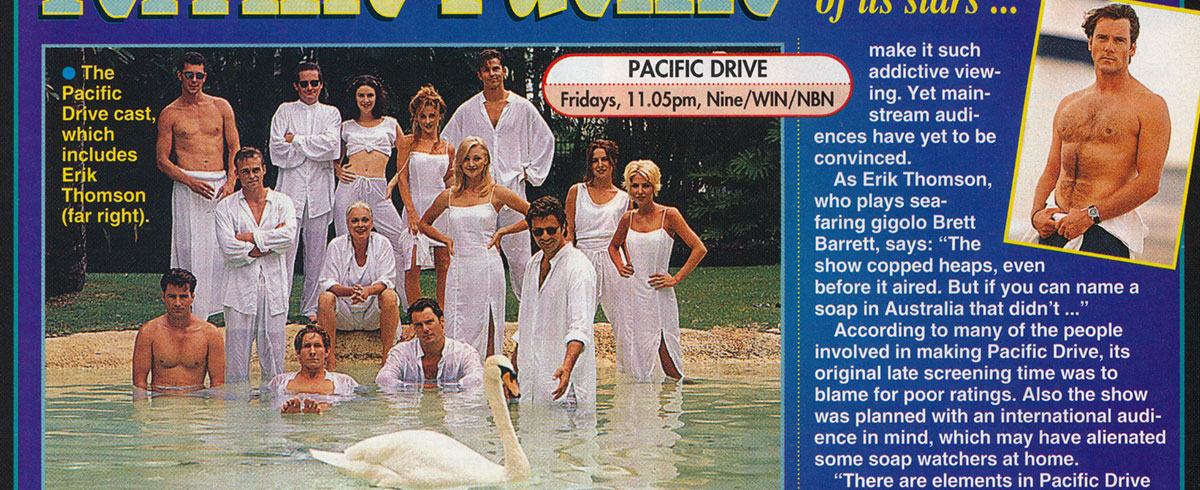
Home-grown Pacific Drive every bit as good as Melrose says one of its stars.
IT’S been panned by critics and its stars would rather forget they were ever in it, but home-grown raunchy soap Pacific Drive is gradually winning itself an army of fans.
While production has ceased, and financial backers have pulled out, the Nine Network is still screening fresh episodes of the adult drama.
And you can be sure that Australia’s answer to Melrose Place is still sizzling along with ample doses of sun, surf and sex, earning itself cult status among late-night viewers.
It’s the over-the-top storylines that make it such addictive viewing. Yet mainstream audiences have yet to be convinced.
As Erik Thomson, who plays seafaring gigolo Brett Barrett, says: “The show copped heaps, even before it aired. But if you can name a soap in Australia that didn’t…” According to many of the people involved in making Pacific Drive, its original late screening time was to blame for poor ratings. Also the show was planned with an international audience in mind, which may have alienated some soap watchers at home.
“There are elements in Pacific Drive that Aussies will look at differently from overseas audiences,” Erik says.
“I honestly don’t believe that Melrose Place is in any way superior to Pacific Drive. There’s still a cultural cringe here.” Sadly, there are no current plans to resume filming, but there are enough unscreened episodes to keep this soap frothing for a while yet!
TV Flashback recently spoke to Steve Bisley about his time on both Police Rescue and Water Rats. From 1993 to 1995 he played Senior Sergeant Kevin ‘Nipper’ Harris in Police Rescue and after a guest starring role in Water Rats, his character Detective Sergeant Jack Christey took over from popular character Detective Senior Constable Frank Holloway – after Colin Friels’ departure from the show. Special thanks to Via Vision Entreatmentwho organised the interview to help publicise the DVD release of Police Rescue and Water Rats.
1) How did you become involved with Police Rescue?
I was asked to do it. They offered me the role of Nipper. He was the sergeant, he sort of ran the squad in a way. There was another guy above him, another actor, but I sort of ran the operations end of it I guess, dealing with the guys. Gary Sweet, Steve Bastoni, Tammy Macintosh, Sonia Todd, Jeremy Callaghan. It was a joy to play, absolute joy to play. Water Rats was the same. It was one of the last big dramas. After these two shows, certainly after Rats finished, was the start of the reality bite. And so the big dramas went and you had people losing weight, people cooking food, and people renovating houses. That seemed to be where it was all heading and you thought this will go away in a minute, won’t it, and it didn’t.
But I feel the stuff that’s around at the moment is a departure, and I think we’ll go back to really good drama. And I think the quality you can see being pumped out through Netflix and Stan, people like those providers, and Netflix are here now making shows, so it just means everyone is going to have to lift their game. The local providers included. Interesting times.
2) You were pretty much desk bound for most of Police Rescue, did you ever want more action scenes?
I enjoyed where he sat in the show. You didn’t need another fool hanging off a rope, there was enough butch stuff going on. I really enjoyed playing Nipper and I did get to do some stunts.
3) And what about the personal aspects of playing Nipper? Did you enjoy the family side of the character?
Absolutely. It’s really nice, and I think the scripts were great in Police Rescue. I mean I haven’t seen it in a while, but I think it still holds up, and obviously Water Rats too, and I think that’s why they’re releasing them [on DVD], because I think there’s a return to that sort of quality.
4) What were some of the major challenges working on Police Rescue?
The nature of the show. We were a rescue unit, I loved the fact that every week there was a big rescue sequence, there was some really hairy stuff. Abseiling off the harbour bridge, my character had to manually operate a lift that had been stuck and the brakes failed, all that stuff. Gary Sweet abseiling off the QANTAS building in the city. We threw Steve Bastoni off Centrepoint Tower, we had him worried and his eyes were as big as dinner plates when he hit the ground. He didn’t stop jibbering for about a week. That was fairly out there. I loved it and obviously the audience did too.
5) Jack Christey could be a bit of a cowboy, did you enjoy that part of the character?
Yeah. It was just a different way to view the entrance of a new character. It’s often challenging to take over when there’s an established character who’s leaving the show and that baton change is hard to do, it’s challenging from an audiences point of view as well.
6) This might be testing your memory, but did you have a favourite storyline or episode for Police Rescue and Water Rats?
I can remember them all. I’ve got a really good memory, it’s not too good some days. In both shows there was no real standout. I liked everything about both shows, we worked very closely with the Rescue police, we were given all the uniforms, they were the real thing. Normally with police shows you’ve gotta fabricate your own uniform and it can’t be exactly the same as the real coppers, but we were able to, and they would vet all the scripts to make sure what we were doing is what they’d be doing. So you really felt this was as real as we could make it. That was great and I think that comes over on the screen, and there’s enough of each characters personal life in there to keep that side of the show interesting. So I liked them both. There was a bus crash that was pretty interesting and a lot of heartfelt stuff, and people losing their lives and we were trying to rescue them. Equally I loved Water Rats, in both cases huge amount of work to get through in a day. Television is always fast, there’s no mucking around you’ve got to be on song all the time. Theatre runs at a different pace as does film.
7) And did the fast pace cause tension on the set?
No, I think it creates an energy. I don’t think it necessarily create tension, I think people thrive on the energy of it. To get through the sort of hours we were doing, I think all that energy and adrenaline really helped. On both shows actually, because there’s no chance to go back, you keep going and the nature of the shows required that amount of energy on them anyway. Water Rats we were chasing down the baddies, in Rescue we were saving people. People loved that, the public like it too, when the Rescue guys turn up it’s gotta be good. I have immense respect for police, men and women. They’re the people we call when the sh*t hits the fan. It doesn’t matter what it is, we want the police, it’s like calling to your mother. No matter what, they have to attend, they have to go and that’s an extraordinary career to have. Every time the phone goes you don’t know what’s at the end of that call. These kids, police coming out of the academy, they’re in their late teens. They’re seeing the worst side of humanity on a daily basis. Carnage, destruction, sorrow, and grief. It asks a lot of anybody.
8) What will you treasure most from your time working on Police Rescue and Water Rats, from both a professional and personal perspective?
I think the collective of all the performers on both shows. We became very close as a group. We were spending a lot of time together obviously in the execution of those shows, people of like minds and people who were working at a real fast pace and being careful with each other in those situations and helping, being supportive and getting through. Same with the crew. The cast and crew. I’m involved in Doctor Doctor, the last 2 series, the same thing. All those shows, you get a real little microcosm of life. We all get there super early in the morning and it’s still dark and we’re there till the sun goes down and beyond. And that’s our day and that’s the next day, and the next day and the next day. And on and on it goes. It’s an extraordinary camaraderie between a group of people going in one direction, the support and friendship that comes out of that, it’s wonderful.
9) Do you stay in contact with the cast and crew from both shows?
Most all of them.
10) Why do you think Police Rescue and Water Rats were so successful?
Good people working on them, attractive shows to look at, great production values, engaging stories and great scripts. Boom.
11) You left both shows, how do you know when it’s time to leave a show?
I don’t know. Sometimes it’s not of your choosing and sometimes it is. It’s knowing when to hold them and knowing when to fold them.
12) Did you have a favourite show out of Police Rescue or Water Rats?
No. They’re both great shows.
Thanks to Steve Bisley and Via Vision Entertainment.
The much-loved Tom Croydon faces a health crisis in this landmark episode.
The milestone 500th episode of one of Australia’s best-loved drama series, Blue Heelers, hits our screens this week. And what an unforgettable episode it is!
Senior Sergeant Tom Croydon (John Wood) – well regarded as the face of Mount Thomas – is nearly seriously ill. And Tom will receive some shocking news in coming weeks. Is he dying?
When the 500th episode begins, we realise that the pressure of the past couple of years has taken its toll on Tom, whose beloved wife, Grace (Debra Lawrence), was brutally raped and murdered in 2004.
Now, we see that Tom is obviously unwell – and refusing to see a doctor.
“Tom starts having reoccurring nightmares about his childhood,” John says. “He’s been so closed since his wife died.
“He’s also a typical male who thinks, ‘you don’t go to the doctor until you’re absolutely dying,’ and then, of course, it’s too late. He’s had so much happen to him in the last couple of years that he pushes that side of things into the background.”
Meanwhile, Tom’s colleague, Detective Amy Fox (Rachel Gordon), can see that Tom is in serious trouble. And she has a huge battle trying to convince Tom that he must seek help.
“Amy thinks of Tom as a bit of a father-figure,” explains Rachel. “She tries to protect him and care for him as much as she can.”
Rachel says it was “a privilege” to work with John for this storyline.
“He does some fantastic work in this 500th episode,” she enthuses.
As for John, he admits he found the episode confronting to film.
“It’s funny playing someone with a potentially fatal illness,” he says. “You don’t like the idea of doing it ’cause you might be dicing with death yourself – tempting the gods.”
Casting back
Heelers past and present talk fondly about their fave show
Lisa McCune
One of the most popular cast members, Lisa built up a huge following as Mount Thomas sweetheart Maggie Doyle.
“Blue Heelers was such a great show to do because you did get to do everything,” she says. “You got to do the emotional stuff, you got to do the action, you got to do some really heavy storylines as well. And as a young actor, working with some of the country’s finest actors – what a great learning ground!
“I just hope that we continue to make these programs, as lot of really fine actors learn the ropes there.”
Julie Nihill
Along with John Wood, Julie was the only remaining original cast member of Blue Heelers by the time the show filmed its 500th episode. And there’s no question that her alter ego, publican Chris Reilly – described by many as “the heart and soul of Mount Thomas” – has been an essential part of Blue Heelers from day one.
“The show’s been like this gift from heaven,” says Julie, a real-life mother-of-two. “A show like Heelers is like the foundation of any healthy film and television industry. It’s an Australian show that Australians took to heart.”
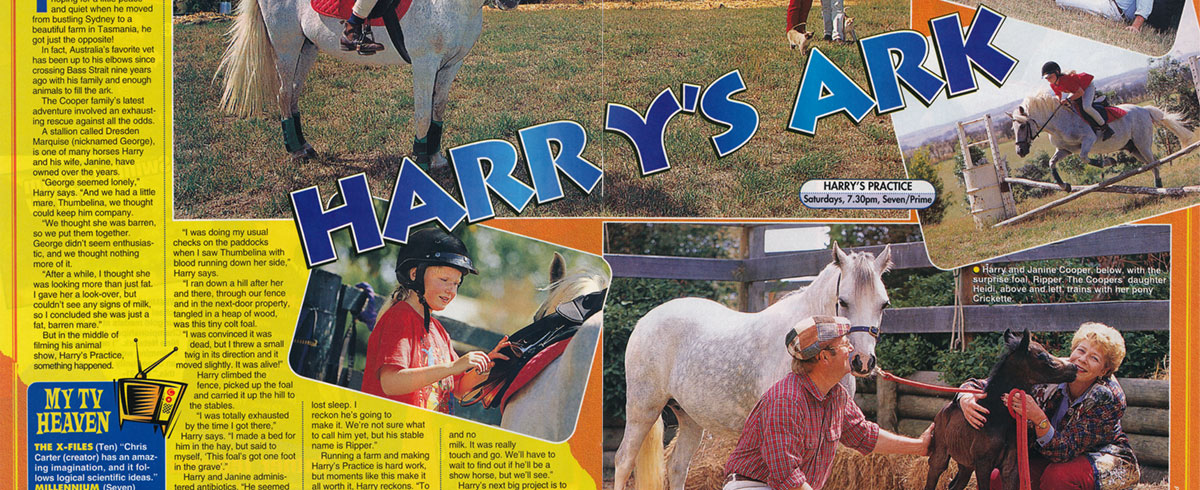
Join Harry and Janine Cooper and their 11-year-old daughter, Heidi, at their beautiful Tasmanian home.
If Dr Harry Cooper was hoping for a little peace and quiet when he moved from bustling Sydney to a beautiful farm in Tasmania, he got just the opposite!
In fact, Australia’s favourite vet has been up to his elbows since crossing Bass Strait nine years ago with his family and enough animals to fill the ark.
The Cooper family’s latest adventure involved an exhausting rescue against all the odds.
A stallion called Dresden Marquise (nicknamed George), is one of many horses Harry and his wife, Janine, have owned over the years.
“George seemed lonely,” Harry says. “And we had a little mare, Thumbelina, we thought could keep him company.
“We thought she was barren, so we put them together. George didn’t seem enthusiastic, and we thought nothing more of it.
“After a while, I thought she was looking more than just fat.
I gave her a look-over, but couldn’t see any signs of milk, so I concluded she was just a fat, barren mare.”
But in the middle of filming his animal show, Harry’s Practice, something happened.
“I was doing my usual checks on the paddocks when I saw Thumbelina with blood running down her side,” Harry says.
“I ran down a hill after her and there, through our fence and in the next-door property, tangled in a heap of wood, was this tiny colt foal.
“I was convinced it was dead, but I threw a small twig in its direction and it moved slightly. It was alive!” Harry climbed the fence, picked up the foal and carried it up the hill to the stables.
“I was totally exhausted by the time I got there,” Harry says. “I made a bed for him in the hay, but said to myself, This foal’s got one foot in the grave’.”
Harry and Janine administered antibiotics. “He seemed so jaundiced,” Harry says. “But with the help of the feeding tube, would you believe the foal started to come around?
“Now it is suckling and we’re getting to catch up on lots of lost sleep. I reckon he’s going to make it. We’re not sure what to call him yet, but his stable name is Ripper.”
Running a farm and making Harry’s Practice is hard work, but moments like this make it all worth it, Harry reckons. “To see a foal like that get up, and suckle and walk is a really fantastic feeling. It was dead and it came back to life,” he says.
“It was lying there in the freezing cold, with no mother and no milk. It was really touch and go. We’ll have to wait to find out if he’ll be a show horse, but we’ll see.” Harry’s next big project is to watch daughter Heidi, 11, develop with her gorgeous pony, Crickette. “She does jumping and dressage and just loves the life here,” he says.
Former ballet dancer Simon Munro portrays a young model coming to terms with the fact he’s gay.
Simon Munro has joined a select group of actors. He is among the very few who have portrayed gay characters on television.
His Breakers character, Vince, a young model, and part-time waiter in the fictional Bondi eatery, Kate’s Cafe, is gradually realising he is homosexual.
In weeks to come, Vince has to deal not only with the personal ramifications of being young and gay, but also with the sometimes negative reactions of those around him.
“He’s only 15, so he’s at that age when people are exploring their sexuality,” Simon says.
One of Vince’s most immediate hurdles is the way his homosexuality will change his close friendship with Danny (Ben Tate).
“It is a touchy topic and one that tests the boundaries of some friendships,” Simon says.
Former Heartbreak High actress Abi Tucker was thrown in at the deep end when she joined the Wildside cast…
With dark cropped hair framing intelligent blue eyes, a confident stride and assured manner, Wildside’s Kate Holbeck is every inch the tough detective. However, look past the severe suit and hairstyle and you’ll notice something very familiar about that lazy smile.
Yes, she may have a completely new look but there is no mistaking the delicate features and distinctive voice of Abi Tucker. Only two years ago she was groovy blonde rock singer Jodie Cooper in Heartbreak High. But now school’s out, the hair is gone and the Abi is all grown up and out to prove her versatility by playing the new detective on the beat in ABC’s Wildside.
“I had never done a role like this before,” Abi says. “Kate is a really strong person. It was out of my own character to play a detective, so it was good, hard acting work.”
After leaving Heartbreak High, Abi farewelled her friends in Sydney and set out for London armed with her backpack and guitar, to concentrate on her singing.
It worked out well, but when an acting opportunity on Wildside came along Abi knew it couldn’t be ignored. She jumped on the next plane home, eager to meet her challenge.
A philosophical kind of girl, Abi is a firm believer that the role came at the right time to lead her on a new path in life.
“If you believe you are on a little path and something brings you back, then you are obviously on the right path,” Abi says “The lease of the house I had in London ran out the day I was due to come back. Some things are just meant to be, I guess.
“I thought Wildside was fantastic,” she says. “I loved the energy of it.”
Abi may have played an easygoing, peace-loving school girl in Heartbreak High, but the Wildside crew was determined to toughen her up.
The first few weeks on the job saw her character Kate shoot a knifewielding maniac, have conflicts with Charlies Coustas (Alex Dimitriades) and deal with the nightmares brought on by the shooting.
“The first scene I had to do was at Central station (in Sydney), in front of all these people,” she remembers. “I was standing there and thinking, ‘Oh my God, here I am – a detective!”. It was good because my character was new, so me being new was an extension of that.
“When I read in the script that I was going to shoot someone, I was up for the challenge. It was weird because that was shot in my first two weeks on the show, so I was still running on nervous energy.”
While Abi relished her time on Wildside, she wasn’t devastated that the Logie Award-winning show was in its final season.
“I was in two minds,” she admits. “It Wildside had gone on I would have been ecstatic. But if it stopped, which it did, I would have been fine about it. Everything has a time and a place.”
In 2009 Sea Patrol script producer Marcia Gardner was interviewed for fan site sea-patrol.com. The interview focused on the scripting process for the naval action series. The interview is being exclusively republished here as it contains a great insight into the challenges of writing for television. Marcia has more recently worked on Wentworth.
1. Can you give us a brief timeline of the gestation of a Sea Patrol script, from idea to release script?
Story kernels are devised in November each year and developed into thirteen (or sixteen in Series 4) storylines making up the “Series Bible” which is delivered prior to Christmas. In late January, the scripting process begins. Scripts are developed in blocks of four and go through the following stages: story conference (during which every beat of the story is mapped out), scene breakdown (a prose description of each scene developed from the story conference notes), first draft (two weeks), second draft (one week), director’s release (a third draft following input from the director) and finally the shooting scripts which are delivered in mid August. So, from idea to shooting script, roughly nine months – a bit like having a baby, times thirteen.
2. You’ve worked on long form mystery dramas including Blue Heelers and Stingers. How does the process differ for Sea Patrol where there is an overarching storyline threaded through 13 episodes?
All drama series have at least one episodic storyline (the plot) and one or more character storylines (the character story/ies). The difference with a mini-series such as Sea Patrol 1, 2 & 3 is there is an additional layer of story that is the mini-series narrative arc. This doesn’t necessarily appear in every episode. It is devised separately from the episodic storylines but threaded through during forward planning and may even become the episodic storyline on occasion when there is a significant enough development e.g. the series will usually conclude with a storyline which wraps up the miniseries arc.
3. How do budget constraints affect the script development process? Eg. are there a certain number of explosions or appearances by the hovercraft allowed per season? Can you give us an example of the process of negotiation and compromise surrounding particular stunts or storylines?
Scripts are always developed with budget constraints in mind and there are general guidelines which are ‘no go’ areas for writers such as extensive at sea action at night or underwater shooting. We have a definite allocation of script pages we can write for the key production locations and studio and must adhere to these guidelines to ensure the production can be shot on time and budget. However, we usually find a way of telling a story within the budgetary limitations. For example, in Episode 11 of Series 3, there is a sequence where Bomber rescues two yachties from their capsized and sinking yacht. As the budget does not allow for a full underwater unit, it was agreed if we could write the sequence for a very limited space, the art department could build a section resembling the inside hull in a purpose built tank, allowing the camera to view the action from outside through a glass portal. In this way, what would have been a prohibitively expensive sequence was achieved to great dramatic effect through the co-operation between script and production.
4. Because scripts for all 13 eps are completed before shooting begins, how difficult is it to make impromptu adjustments when uncontrollable events (eg. Jeremy Lindsay Taylor’s calf injury) occur? Do injury/illness/weather/watercraft-related inconveniences ever end up unexpectedly benefiting a story?
Since all scripts are locked before shooting begins, any minor amendments necessary during production are made by the production office on site. In the case of Jeremy’s calf injury, it was decided to replace his character with Robert in the story and any amendments to dialogue for character were agreed on between director and actor – a relatively simple adjustment. However, when a situation arises that requires rebuilding a story, then one of the writing team – usually myself – will be called upon to undertake whatever rewriting is necessary. Fortunately, this didn’t occur on Series 3. It was nice to see Robert in Episode 5 take on a leadership role in Buffer’s absence even if it wasn’t plotted that way – so sometimes impromptu amendments can make for a refreshing change. Wouldn’t want to make a habit of it though as of course, it might not always work out as well!
5. Can a scriptwriter ever be truly 100% happy with a script? Are there times when you have been disappointed by the end product of a special episode or, conversely, surprised when a weaker script turns out better than expected?
Working on a television series is a huge collaboration of many highly skilled and talented individuals. The script is the blueprint for this process and, as such, is subject to interpretation by a number of other key creative people. Therefore, the end product is rarely exactly as you’d imagined it while banging on at the computer. It often happens that some aspect of an episode will disappoint while another you considered to be a bit soft will delight beyond all expectation. The desired outcome is for each aspect of production to value add to the script and take it to the next level. When this happens, the writers are happy.
6. There are ten primary characters in Sea Patrol. How great a challenge is it to divide major storylines equally?
Sea Patrol is scripted as an ensemble. This means that in a series, each character gets at least one episode in which they are featured. The challenge is to find an action storyline which will explore some aspect of that character so it becomes a journey for them as well as an intriguing plot.
7. Obviously Sea Patrol’s close working relationship with the real RAN is paramount to production. Are there storylines that you would like to explore but can’t because of this relationship?
Because of the non-fraternisation rule aboard Navy ships, we cannot depict sexual relationships between crew members. Obviously it’s also tricky to have a ‘bad’ character who is one of our sailors as we try to avoid portraying Navy in a negative light.
8. At what point does the Navy advisor enter the script process? How much say so the navy have on the story?
A Navy advisor attends our story conferences and reads and comments on every draft of the script. Generally speaking they confine their input to aspects of procedure, technical advice and matters affecting Navy reputation. This inevitably affects how the story is told but not what story is told.
9. As the seasons progress and you see what each actor brings to their specific role, do you find yourself writing for the actors rather than just the characters?
As we get to know the actors we try to play to their strengths and minimise any weaknesses. Some actors will offer interesting interpretations of a line or scene that we may pick up on and decide to push the character even further in that direction. Although our ability to be responsive to performance is limited by the fact the entire series is shot in one block, so any development we do decide to make won’t take effect until the next series.
10. Some media commentators have suggested that there is a limit to the number of stories that can be generated from life on a ship and Naval duty. If Sea Patrol continues for several more years, how will you meet this challenge and prevent rehashing the same plots?
Before we start the storylining process for each series, we do a research trip to Cairns ACPB base and spend a few days talking with sailors and hearing their anecdotes about Navy life and their experiences. Usually out of that we are able to extract enough story kernels to build a series of episodes. We believe there are as many more stories as there are sailors yet to meet – everybody has one.
Thanks to Marcia Gardner for great insight into creating the stories for Sea Patrol. You can see some scenes from episodes Marcia wrote throughout the series below:
Georgie Parker gets hot under the collar about the making of her newest TV series.
Georgie Parker describes the making of her latest series, Fire, as “a nightmare”.
Working in steamy Queensland, wearing heavy fire-fighting gear all day and filming among real flames was an almost unbearable mix that drew Georgie and the other cast members close to breaking point.
“It was extraordinarily difficult,” she says. “The conditions affected everyone’s mood, There were a lot of tempers flaring, a lot of volatile situations.
“That was also because the story itself Is volatile. Life imitated art, but in a strange way the tension bonded us together.”
Georgie says that during the five-month shoot in Brisbane for the Seven Network’s new drama series, in which she stars as firefighter Morgan “Mad Dog” Cartwright. she asked herself many times why she had accepted such an exhausting job.
“I asked myself that just about every day,” she says. “I thought the shoot would never end.
“I’ve never felt heat like that. The only difference was when you stepped into one of the air-conditioned vehicles. It was like getting into a bed with crisp white sheets, and you just didn’t want to leave it.”
Because of the heat and the dangers of dehydration, nurses were on hand during filming to give cast members electrolyte solutions, vitamins and other supplements.
“We were sweating all day. It was vile,” Georgie says.
“It was the most unglamorous shoot I’ve done in my life. But that was part of the bonding again, because we were all the same – we all looked like s—!”
After hours, the cast didn’t socialise much. she adds.
“Because we were all hot and all bothered, we didn’t want to spend a lot of time together. But the crew were wonderful. They were very sensitive to how everyone was feeling, and they were so supportive,” she says.
Despite the difficult conditions, there were some lighter moments during filming, often prompted by Andy Anderson, who plays Repo.
“Whatever musical was on in Brisbane at the time, we’d be singing the songs on set,” Georgie says. “So we’d be in our fire turnout gear singing Jesus Christ Superstar!”
The series also features Peter Phelps, Debora-Lee Furness, Max Phipps, Shane Feeney-Connor, Liddy Clark, Wayne Pygram, Tayler Kane and Aaron Jeffery.
Fire, to premiere next month, is the story of Morgan Cartwright, the first female firefighter in Brisbane (there are none in real life).
Initially, Morgan has a tough time, firstly getting into the force and then being accepted as just another firefighter.
“The script deals with the sexism issue in the first episode, and then dismisses it altogether,” Georgie says.
“That pleased me, because the more that is made of this issue, the harder it is to break that stereotype.”
Fire doesn’t exaggerate the depth of feeling some members of the force have against women joining them on the job, Georgie says.
“They’re so proud of it being such a male-dominated industry. I say, think about all the things women can bring to the job rather than the things they can’t.
“Stingy old bastards! It’s like, when will this cease to be an issue?”
Georgie does, however, have a lot of praise for the job firefighters do and for the Queensland officers who were advisers on the Fire set.
“They were so helpful,” she says “They were on set every day, and they were there for us whenever we needed something.”
The main thing that has stopped more women becoming firefighters is the physical strength required for the job.
“It’s 90 per cent physical. The equipment is very heavy. You need two or three people to hold a hose,” Georgie says.
She was able to cope with the physical requirements during a two-week training course with the Queensland Fire Service thanks to her normal, rigorous routine.”
“I like to work out for two hours a day, seven days a week,” she says.
“I swim, run. I go to the gym and do weights and body toning. I do yoga and kickboxing. I’ve been a dancer since I was four, so I just love it.”
The triple TV Week Silver Logie Award winner is best remembered for her role as Lucy Gardiner in A Country Practice from 1989 to 1992.
She is currently starring as Sandy Spencer, with Nicholas Eadie, in Seven’s comedy series Over The Hill.
Question: What would be the highs and lows of acting?
Jay: Highs and lows would be doing the nude scene in the recent episode of Rats. Itís not easy pulling your pants down in front of forty crew members.
Question: What is it like working on Water Rats and occasionally Xena: Warrior Princess?
Jay: What I like about working on both these series is that on one show you get to play the straight good guy, there to lend a helping hand and the other you’re the bad guy ready to chop off a helping hand.
Question: What is your birth-date and star sign?
Jay: September 10, 1963. I’m a virgo and I like my star sign.
Question: Where would you like to see your character head in Water Rats?
Jay: I would like to take him a little more off the water and work on land. Not so much with the leads-co-stars Colin Friels and Catherine McClements – but with McCall (Scott Burgess) and Blakemore (Toni Scalan).
Question: How did you get picked for Water Rats?
Jay: I was working in New Zealand when a call came from Southern Star with a request to see me on tape. I taped an interview and got a call back saying pack your bags you’re flying to Australia. And the rest is history.
Toni Scanlan (aka Sgt Helen Blakemore)
Question: Apart from working on Water Rats, what do you do in your spare time?
Toni: Cook for friends, which makes me nervous, but I like the challenge.
Question: What would be the highs and lows of acting, especially on Water Rats?
Toni: Highs-working on an island in the middle of the harbour! Lows-working on an island in the middle of the harbour!
Question: What is your birthdate and star sign?
Toni: I’m an Aries and I was born on April 2, 1956.
Question: If you could be anybody in the world, who would you be? And why?
Toni: Maxine McKew. She’s a fantastic journalist, great interview and not bad looking either. Seriously, I’d like to have her brains and the ease with which she deals with all kinds of people.
Question: What other work have you done other than acting? And what was your first job?
Toni: My first job was selling jeans in Jeans West. I’ve been involved in retail clothing and secretarial work.
Question: Have you ever made a stuff-up when filming Water Rats?
Toni: Often, but one time working with Colin Friels (Det. Frank Holloway) I could not get my lines out. I finally squeezed them out and when I saw it later it was shocking!
Question: What are your favourite foods?
Toni: Moroccan food with all its fruits and perfumes combined with lamb and cous cous, and a bottle of pinot noir. Yum!
Question: “Do you get quizzed about the show? Does this annoy you?
Toni: People are generally polite. They’ll say, ‘Hi’, or tell you they enjoy the show, but I’ve never been quizzed. Most folk know the difference between real life and fiction. So, when they meet you, they’re responding to you the actor, not the character and that is far from annoying.
Veteran actor Bill Young (Hacksaw Ridge, Chopper, The Matrix) appeared in the first 19 episodes of Water Rats as Chief Inspector Clarke Webb. TV Flashback caught up with Bill to learn more about his short run on the highly successful action series.
1) How did you become involved with Water Rats?
It was through a standard audition process. I think my agent had done quite a sell on me to Hal McElroy the producer and so the audition at Faith Martins (the casting director) went well. I remember feeling good about it when I left.
2) Any similarities between Clarke Webb and Bill Young?
Well…he looks like me and is exactly the same height! My career in this industry has seen me primarily play two types of characters – man of authority, and rural f*ckwit. Clarke Webb sat comfortably within the ‘man of authority’ parameters. I think my height (197cm) has convinced directors over the years that I would have a degree of authority. I have played many, many cop roles in my career – starting with a Probationary Constable in ‘Listen to the Lion’ in 1977, through to Chief Inspector in ‘Water Rats’ (1996), and then back to long serving Sergeant in ‘The Cut’ (2008)
3) What was it like playing a character that had a working class background but had risen to a senior role in the water police? Did that level of depth make it easier or harder to play Clarke Webb?
It’s always easier when there is a career arc for a character rather than just a description. We received a detailed personal history of each character which was handy. Much better than the familiar ‘he’s a hard but fair man’.
4) Your character had a strong relationship with Frank (Colin Friels) and Goldie (Catherine McClements), what was it like to work closely with Colin and Catherine?
Friels and I got on well and scenes with him were always enjoyable. We both had a healthy degree of cynicism about the industry and I think that’s where we clicked. Both Colin and Catherine were highly professional and a pleasure to work with which makes life easier on the set with a tight schedule.
5) Water Rats was a big action series, did you want to be more involved in the action scenes or were you happy mostly staying at water police HQ?
I would’ve loved doing more action stuff out on location around Sydney Harbour but as the boss my stuff tended to be in the office or in a hallway. It was always a pleasure to go to work on Goat Island – lovely way to start the day! A coffee, a boat ride, and then a wander around the island – what could be better? In the opening double episode I actually did get to do a bit of action, but as the schedule tightened, things started to become more office bound. In fact even the divers spent less and less time in the water.
6) What was it like shooting on Sydney Harbour day in and day out? Did you ever get bored of the view?
Never. It was a glorious location. One thing however was problematic. One would think that being isolated on a small island on Sydney Harbour would be quite quiet and good for the sound recordist, but that was not the case. Water, harbour traffic and trains crossing the bridge is VERY noisey. We had to be miked very tightly and pitch up if we were outside the Water Rats’ offices.
7) The shooting schedule for Water Rats was very gruelling, how did the cast and crew cope with the long days?
It was tough for others, in particular the principals, but not so much for me. Some days might be flat out, but generally Clarke Webb wasn’t worked too hard! However those like the divers and the boat crew would sometimes spend a long day out on the harbour and in the sun and that would certainly see them earning the money.
8) Your character left Water Rats in the first series, was this always planned? How did you feel about your character leaving early on? Do you feel that Clarke had more to give?
It was always planned that way. I knew I was only doing the first series. I was very happy with that because Webb was just a supporting character and I didn’t wish to be typecast as that character as that makes it hard to get future work. Also I believe the series slowly went downhill the longer it went. I think the first 26 eps really represented the show well. The longer it went it just became yet another cop show – the hook of having divers and boats and Sydney Harbour receded, and the ‘water rats’ element disappeared. If the role of Clarke Webb had expanded, rather than as it was (desk bound and “I’ll have your badge, Frank!”), then I could possibly have been convinced to stay, but I was very happy with the decision to leave when I did.
9) Out of the 19 episodes you worked on, did you have a favourite? Or a favourite storyline?
Nope – not really. Maybe the marriage bust up was an interesting one for me, as Webb could be seen in a different light, rather than just ‘The Boss’. Working with Linden Wilkinson and Liz Birch was a nice change – lover and (ex) wife.
10) What made Water Rats different from other productions you’ve worked on?
The location. Pure and simple. It had a point of difference and Sydney Harbour is also one of the most beautiful spots in the world. Also having Colin Friels on board was terrific as he added serious cred to the show. Colin’s a fascinating actor to watch and to work with. We became pretty good mates. I shot a short film with him a few years later and it was great to catch up.
11) What will you treasure most from your time working on Water Rats, from both a professional and personal perspective?
My ‘Clarke Webb’ desk nameplate that the art department gave me! Sits proudly in my office. But seriously, it was a great experience to work with a professional ensemble of actors and watch a greaty crew work seamlessly to a very tight schedule.
12) What have you been up to recently?
I continue doing voiceover work on a regular basis and have just finished a 12 week run in a new David Williamson play which was highly successful – packed houses. And I’ve had the good fortune to appear in films such as The Great Gatsby and Hacksaw Ridge, as well as on TV in shows such as House of Bond and Rake. I also co-directed a documentary, A Very Short War, for The History Channel and the ABC. So, can’t complain – get you nowhere, anyway!
John Wood is off to Bali – his first proper holiday in his entire career!
John Wood can not remember taking a genuine holiday during the course of his working career. Sure, there’s been the odd break or two, a few quiet days here and there, but really, that’s about it until now.
John, who plays Blue Heelers Tom Croydon, is planning a trip to Bali with his long-suffering wife, Leslie, and he’s feeling pretty good about it.
“Leslie and I are looking forward to it immensely,” he says.
We’re going for 10 days with a group of friends. We’ve never done it before and it’s time, it’s absolutely time.”
You may be tempted to ask why he’s waited so long, but it doesn’t take much to figure it out. He’s an actor and when you’re in the acting profession and you’re offered work, you grab it with both hands.
“In acting, it tends to be a feast or famine,” John says.
“If the job’s there you take it. If you knock it back to take a holiday, you might come back and find out you don’t have a job.”
With a schedule that includes a top-rating weekly series, hours and hours of publicity commitments and a healthy theatre career, spare time is a luxury for John.
To make matters worse, John is one of those rare men who can’t say no.
“It is hard to refuse, very hard,” he says.
“Particularly if it’s work Being a charity or something like that. How can you say no when you’re asked to appear at a primary school fundraiser, especially when it’s clear how much it means to those asking. They think it’s going to change the world and that makes it hard to knock it back, but you have to sometimes.”
John is becoming only too aware of this. He is currently suffering from asthma and has only recovered from a bout of bronchitis and laryngitis, following a stint treading the boards in the classic David Williamson play The Club.
What concerns him is that he has always burned the candle at both ends.
In the past, however, his body has coped with it
“I hope this isn’t a sign of things to come, an indication that I no longer have the stamina,” he says.
“Theatre is important to me, I don’t want to have to give it up.”
John loves his theatre, but he has no intentions of giving Blue Heelers away either. He’s been with the TV WEEK Logie Award-winning series since it started in 1994.
Being a Heeler has lost none of its gloss for John.
“I’m not sick of it at all, no, definitely not,”
“He (Tom), and the other characters, have a degree of complexity that keeps them interesting. They aren’t two dimensional, they have all the foibles of normal human beings and I think they, and the series, retain a sense of freshness.”
Blue Heelers will soon celebrate the screening of its 200th episode and John can’t quite believe it.
“I thought it would be a successful show, but I never thought it would be this successful for this long, not in a fit,” John says. ” To do one or two series, fair enough, but this many … it’s unbelievable.