HALF A CENTURY AGO, visionaries imported an oversized maccano set and constructed a bridge over Sydney Harbour.
To mark the 50th anniversary of the old coat-hanger, the authorities stopped traffic and allowed pedestrians to wander at large upon the roadway. A nice gesture, but hardly novel. Nothing has been able to move there at more than a walking pace for years.
The TV industry celebrated the occasion with an outburst of artistic creativity. Every news service did its thing, and there was a welter of lightweight documentaries. Sadly, none were very praiseworthy.
Worst of all was the ABC’s effort, which coincided with its own 50th anniversary. It was outstandingly dull. The research was superficial, the script amateurish, the commentary monotonous. Even the archive footage was uninteresting.
It was apparently underwritten in some way by the NSW DePartment of Main Roads, which makes it even more an inexcusable waste of public money. After all the Bridge itself isn’t yet paid for, and by the time the State of NSW frees itself from the clutches of the moneylenders the poor old thing will be falling down.
The Bridge is more than a landmark, more than an engineering feat’ It is a national symbol. And when it does finally succumb to rust and metal fatigue, the pity is that probably only this dreary, inept documentary will survive to recall its days of glorY.
OF COURSE, THE FINANCIAL involvement, direct or indirect, or other government bodies in ABC projects – logistical help, for instance is a good idea. Visionary. Far-sighted. In line with suggestions made in the Dix report.
The subject of money used to be a sordid one at the ABC, unless it involved squandering vast sums on something silly. a few years back,I remember, there was acute embarrassment when the publishingr division, with a mere handful of staff, actuallY oPerated at a Profit.
In drama, the ABC has involved itself in a number of co-productions which might, or might not, have ended up in the black. It doesn’t much matter. At least, it was trying, and the idea of using outside investment to boost local production budgets is commendable.
But there are wicked whispers of interstate rivalries frustrating the commercial aspirations of ABC producers. There are irresponsible rumours of an unfinished studio limiting colour production. There are shocking stories about erased tapes of saleable episodes of the serial Certain Women.
There is a terrible tale regarding a series called Patrol Boat. This was never what could be called a hot property. It dealt with the men of a branch of the service which protects our shores from invasion of one kind or another.
Mostly, the actors were called upon to salute and say “sir” a lot as they bobbed up and down upon the waves. It was so genteel, so neat, so crisply starched and pressed. Young Andrew MacFarlane was made to look more like an air hostess than a naval officer, and the rest of the crew resembled a chorus line about to burst into song and do a quick number from Anchors Aweigh.
But the series had enough going for it to be sold overseas. The buyers wanted more, another series in fact, for which they were prepared to pay big bikkies. Alas, the ABC could not oblige. Dear me, it hadn’t been allowed for a budget planning. Perhaps in a year or two…
Well, three or four years have passed, and I hear that the series is about to be revived. I understand that Ted Roberts has been rented to write 13 episodes. Mr Roberts is a good hand, with a talent for turning out marketable stuff. If the ABC leaves him alone, it might find itself with something viable, even profitable, on its list.
I must point out that there is nothing novel in this, either. There are some clever people at the ABC with a cunning eye upon the main chance, sweating on a chance to demonstrate how they can snap up a quid out in the market place.
As proof, I offer a thing called Auntie Jack. This alleged entertainment featured a man in drag wearing boxing gloves, and was watched by practically nobody. It was, like most ABC comedy, a waste of money. But a few weeks back, some of that money came back. Not from the sale of the show, of course. From the sale of a chair. Yes, the very chair upon which Auntie Jack sat brought $350 at an auction of surplus government stores.
Which proves that there are still visionaries about. Whoever chose that chair for Graham Bond to park his bottom on was a very far-sighted fellow indeed.
Original content copyright The Australian Women’s Weekly.
Steve Bisley previously spoke with TV Flashback about his time on Police Rescue and Water Rats. He’s currently busy raising funds for a new mental health project, to help promote the cause TV Flashback caught up with Steve to find out about his time on the third and final series of Frontline.
1) How did you become involved with Frontline?
I was living in Leura, in the Blue Mountains west of Sydney. I was between agents at the time and was representing myself. One morning I got a call from Jane Kennedy and she asked me whether I would consider playing the role of the executive producer on the show. Bruno Lawrence a fantastic Kiwi actor had played the role in the first series but had sadly passed away. Jane asked me if I would consider flying to Melbourne to meet with the team to discuss. I did.
2) Had you seen the show before joining? Were you keen to join?
I had been an avid watcher of the series and loved it.
When I met with the Working Dog bunch in Melbourne, we sat around telling stories about E.P.’s we had all worked with and out of those stories and their take on the character, and some input from me, Prowsey was born.
3) What did you think of the documentary style of shooting? Did it make it easier or harder to perform?
I loved the way in which the show was shot. Rather than having a large camera with a bunch of technicians around it, the show was shot with small mostly hand held cameras, so I never felt restricted or constrained by the technical side of filming. We worked fast and that kept the energy levels up.
4) Working Dog are known for keeping a tight rein on the story and script and you’re known for adlibbing, did you manage to find a happy medium in that environment?
The storylines were fantastic and the scripts were really tight, so I rarely departed from the script, only went I felt like being naughty.
5) A lot of people praised Frontline for its accuracy, not just with journalism but with the entertainment industry as a whole, since you’ve worked in the entertainment industry for so long, how accurate do you think it was?
The scripts were not only funny, they were accurate, poignant, and politically corrosive.
And they educated people in how much bullshit there was, and is, in current affairs.
6) Graeme Prowse was hot headed, sexist and hard to work with (but he could play the game) how did you find it playing a character like that?
E.P.’s have no soul, that’s in the job description. He was an absolute delight to play.
7) You did an episode that was almost entirely shot with just you and guest star Jeremy Sims, what was that like to do? Did you enjoy the focus being on your character?
Yes, the episode was called ‘The Art Of the Interview’ and it showed how manipulative Prowsey was, especially in the way he massaged Rob Sitch’s character’s ego, to get exactly what he wanted from him.
8) Did you have a favourite episode or storyline?
No favourites, I loved them all, especially when I got to call someone a ‘soft cock’.
9) What was it like on set? Was it hard to keep a straight face sometimes?
I have never laughed so much in my life!
10) Do you think Frontline would still work now?
I think this world is more than ready for more Frontline.
11) Would you be keen to play Prowsey again if the opportunity presented itself?
In a heartbeat! Older now, but no wiser!
12) What will you treasure most from your time working on Frontline?
It is a rare thing in the industry to be trusted with a project that offered its performers such beautifully crafted stories and characters that live long in the hearts of the audience.
13) You’re currently fundraising for a big cause, tell us more about that?
I have a GoFundme campaign, running to raise funds for the awareness and prevention of suicide in Australia. I am riding a motorbike around Australia to form a network of cities and towns called ‘Compassionate Communities’ to help people better understand a problem that touches us all. We need all the help we can get! People can donate at: gf.me/u/ymbnst.
Thanks to Steve for great insight into one of Australia’s much loved and respected sitcoms. We’d love to see it back on screen. If you can donate, please make sure you do, it’s such a worthwhile cause.
Warning: don’t watch the opening scene of this episode over dinner, or you may never look at humble cling wrap the same way again!
Unsavoury matters aside this week’s storyline has one killer twist. It sees a dubious Matt (Damien Richardson) and Duncan (Aaron Pedersen) interview a frantic woman who turned up wanting to report a brutal murder. There’s just one catch: the crime hasn’t actually happened yet!
“But it’s going to unless you do something,” promises the woman, who claims to be a psychic.
Four days later; a weighed-down body is pulled out of the ocean.The dead woman was tortured, exactly as predicted. And the detectives are even more baffled when the psychic turns up on their missing-persons list.
But it’s Duncan who’s most affected by the case. Usually the sceptic of the bunch, he finds himself looking at the death of his girlfriend Claire (Kat Stewart) in an entirely new light.
Best Line
After Simon (Dan MacPherson) reveals he once dated a girl whose mother was a psychic, Duncan responds: “Why did she let her daughter go out with you then?”
Andrew Blackman starred as Dr Harry Morrison in A Country Practice from 1991 until the series ended in 1993, he also reprised the role for the Channel Ten version which aired in 1994. TV Flashback caught up with Andrew to find out about his time on one of the most successful and loved dramas…
1) How did you become involved with A Country Practice?
I was completing my final year at NIDA and had the good fortune to land a lead role in our graduating production. None of us knew what was going to happen, of course, we had just spent three years working closely together and we were acutely aware that the prospect of ongoing work in our chosen profession would always be slim. There was some interest from a couple of production companies that were working with Channel 7 and I became aware through one of our tutors that Shauna Crowley, the casting director at JNP Productions, was scouting for a new young doctor to join the cast of A Country Practice. Before we wrapped the year I was invited to audition for the role of Dr Harry Morrison. I knew things were getting serious when I was called back to work with Shane Porteous, who had played the immensely popular Terrence Elliott from the inception of the series. Nerves nearly got the better of me on the day and I remember coming away thinking, ‘Well, that was that’. I was setting tables at the Bennelong Restaurant at the Opera House when I got the call a few days later. That was the last day I worked in hospitality.
2) Did you do any research for the role?
The show had three full-time nurses who doubled as medical consultants. they worked closely with the script department as advisors on storylines to make sure that the appropriate procedures were followed. It was important that storylines reflected real medical situations. They would also be on hand during filming to make sure that the actors were following the correct medical procedures at all times. They were a valuable and accessible source of research on a day-to-day basis.
Part of my induction was a prearranged visit to the Royal Prince Alfred Hospital. Maureen Edwards had just started as the new Wandin Valley Matron and together we were taken through each department to see how a functioning hospital operated. Visiting theatre during an operation was a completely fascinating experience but the most memorable moment was a trip to the City Morgue. I found it morbidly satisfying at first but had to quickly leave when I was shown the body of poor gentleman who had lost his life while attempting to board a train. For all the make-believe and storytelling that is part of my job, this was a sobering dose of reality.
3) What was it like joining a long running and very popular show?
Enormously exciting! Here was I, a drama school graduate in his mid-twenties, still very raw and green joining the most popular and respected long running television show of it’s era. I was excited and nervous all at once; all of a sudden it was very real. Questions of doubt crossed my mind, would I fit in? Would I make a mess of it and embarrass everybody? But, no. The cast and crew were absolutely welcoming. Many of the scenes on my first shoot day were with Lorrae Desmond, of whom I was in complete awe. She had such a long back catalogue of work, had lived in the UK, had her own TV and radio show and worked with some extraordinary people. I’ll never forget her generosity on that first nervous day.
Apart from a core cast, a series like A Country Practice relied on a revolving door of actors to play guest roles. One of the most enjoyable takeaways was having the opportunity to work with the best actors in Australia. Learning from actors whose careers began before television was invented, people like Charles ‘Bud’ Tingwell, was a great joy. And those whose careers were just beginning, David Wenham and Jacqueline McKenzie spring to mind.
4) What aspects of Harry Morrison did you enjoy playing?
Harry took himself very seriously in the early days of his career but as he learned the ropes at Wandin Valley he loosened up and was happy to show more sides to his personality. He was very caring and empathetic; saving lives and the health of those he treated were his highest priority. He was a gun golfer, which I always enjoyed because I’m not. He was a country boy, as I was, and rode horses. When the producers realised that horsemanship was a particular strength of mine a whole lot of new storylines opened up. That was exciting. He was a romantic and a bit of a dag at times which allowed for plenty of comedy. Every week was conflict, drama and resolution. It was all enjoyable.
5) Some of the scenes in A Country Practice were horrific (car accidents, plus emergency operations etc), did you have any issues dealing with some of the more gory scenes?
No, I loved it. Car chases, being held hostage, shot in the leg with an arrow, an out of control hot air balloon and arriving late for my wedding on horseback. Much of it was challenging but in the end we are making drama. It is an actors dream to have such juicy stuff to work on.
6) Do you remember much about the shooting schedule? Doing so many hours of television a year must have meant long days?
The days were very long, 10 hours generally. We would shoot approximately 2 x 45 minutes of television each week for 44 weeks. A two week period would consist of 2 blocks, each block was made up of 2 x 45 minute episodes. We would shoot the OB (outside broadcast), now known as location, for Block 2 and film the indoor scenes in studio for Block 1 concurrently. So that’s 66 hours of content per year. It was a well oiled machine to say the least. The studio scenes were filmed on set at the Channel 7 Studios in Epping, Sydney. Three cameras filmed the action which was recorded and edited live to video tape. Cutting edge technology at the time. The work load moved around but being a member of the young cast we were granted the lions share.
7) What was it like working with a big ensemble? Was it a fun set?
It was hilarious, a wonderful environment to work in and a testament to the producing team to cast such a diverse range of personalities. From the infectious laughter of Georgie Parker and constant joking of Syd Heylan, to the quiet professionalism of Shane Porteus and gruff grandstanding of Brian Wenzel there was never a dull moment.
8) What was it like working so closely with Michelle Pettigrove (Kate)? Did you enjoy the pairing?
What a joy! Michelle is brilliant and her effervesce is contagious. Yes, we were very close and bounced off each other with ease. Like all married couples we had our moments, notwithstanding I’d love the opportunity to work with her again at this stage of life.
9) Did you have a favourite episode or storyline?
There were so many. Episode 1058, the climatic ending that saw Wandin Valley razed by fire has to be my favourite. It was such a well written, well produced episode full of symbolism.
A particularly emotionally challenging storyline involved a car accident and its aftermath.
Returning from a Harry and Kate send-off at the club, Esme comes across the accident scene. Harry, who was driving comes out of the accident with a collapsed lung, Kate with a fractured arm, but a new nurse, Jules Goodfellow is paralysed from the waist down. Over the ensuing episodes Harry, wracked with guilt and holding himself responsible for the accident, takes it on himself to be carer throughout rehabilitation. Spending more and more time with Jules, played by Loene Carmen, a romance develops that leads to a series of complicated outcomes.
10) Were you surprised when they announced the series was ending on Seven? What were the reactions on set?
I was on set the day that creator James Davern and the Channel 7 executives came in to give us the news. We were shocked, we all were. Georgie Parker had won Logies for the previous four years, we thought we might be immune. In many ways it wasn’t unexpected. 7 Media had just become a publicly listed company and the all important ratings were drifting sideways. The generation that had grown up with Molly had indeed grown up and the appetite for renewal at Wandin Valley was waning. The television programming landscape was evolving. There were plenty of tears but we still had a couple of months of TV to deliver and we made sure we went out on a high.
11) Ten created a new version of the show a year later, which you joined. Many feel this version never captured the magic of the Seven series. What were your thoughts on the new series? Do you think it could have grown into something special given more of a chance?
I agree, the Ten series didn’t ever capture the magic of the original series. Could it grown into something special? You know, I don’t think so. There was some crossover continuity in casting which you had to have; I came across as did Joyce Jacobs as Esme, Paul Gleeson as the Park Ranger and Joan Sydney returned as Matron but it was the locations that made it such a dramatically different show. Emerald, in the Dandenong Ranges is beautiful, as is the Yarra Valley but they were not Wandin Valley, the Hawkesbury River and the plains of Pitt Town, Wilberforce and Windsor. It was a different country. It rained constantly in the cold winter of 1994. It was a stab in the dark by Channel 10 to grab Channel 7 viewers but the loyal audience of old ACP weren’t buying it. They had already moved over to Mt Thomas and cops in the country instead. The baton was handed to Blue Heelers to pick up where A Country Practice left off and would run for 13 years creating jobs and careers and a whole lot of viewing enjoyment on the way. Everything has its time.
12) What will you treasure most from your time working on A Country Practice, from both a professional and personal perspective?
Working with such a brilliant cast and crew for a start. I forged life long relationship during my time on that show. It was a formative experience for me artistically and shaped my work ethic. There are many lesson I have taken forward into my career – to take the work seriously but not to take myself too seriously, egos get in the way of true creativity, always be prepared and ready to contribute to the ensemble, you know the old adage – the whole is worth much more that the sum of the parts.
13) What have you been up to recently?
My most recent work on screen was with Bloom Series 2, screening on Stan. I continue to work regularly in television and theatre, though the events of 2020 have made this increasingly difficult.
I am artistic director of Complete Works Theatre Company. The company produces educational resources through performance for the Victorian education sector and is increasingly moving online in response to the Covid-19 pandemic.
Thanks to Andrew for a wonderful look back at his time on A Country Practice. If you’d love to see Andrew’s arrival into Wandin Valley, you can now purchase the Season 11 boxset on DVD.
You can see Andrew Blackman in scenes from A Country Practice in the video below:
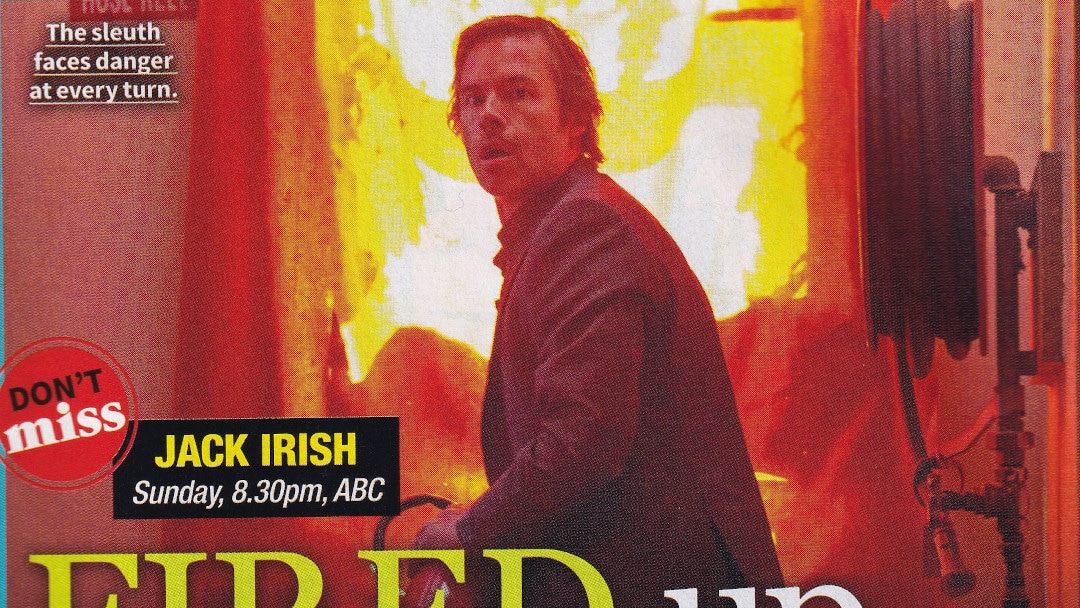
His catourful career has landed former criminal [awyer and now part-time investigator Jack lrish in some odd situations. But locked in the boot of a.car in the middle of nowhere is definitelY a first!
ln Jack Irish this week, Jack (Guy Pearce) is convinced his kidnapping is linked to the deaths of courier Eddie {George Zhao} and international student Lakshmi (Rubi Balasingam).
He also thinks it’s possibly all part of a government conspiracy. The problem is that nobody – including the police – belieVes him.
Dark forces are circling, and before Iong, Jack is putting out fires all around him, He realises the principal of the school Lakshmi attended, Meritus Institute’s Anoushka (Leah Vandenberg, is lying around the former student’s ashes.
“One of the things that happens with Jack is he starts off with something small and then realises, behind the crimes, there’s a bigger threat” Guy 50, says. “He gets himself in deeper and deePer.”
But at least there’s some hope in Jack’s life – love is in the air. Suspecting her ex might be on to a story after all, journalist Linda (Marta Dusseldorp) offers to look into his claims.
Meanwhile, psychologist Rory Finch (Danielle Cormack) offers Jack moral support – and more.
“Jack gets himself involved in a new love story,” Guy teases. “Which is much more complex than he thought it would be.”
It’ll surely be complex, but Jack just might find his happy ending – if he can stay alive long enough, that is!
Thanks to Via Vision we have 2 copies of Rescue Special Ops (The Complete Collection) and A Country Practice (Season 11) on DVD to giveaway. To enter you must fill out the form and agree to the terms and conditions:
Terms & Conditions:
This giveaway is only open to Australian residents.
You can only enter once. (Please note: All IP addresses are being logged).
You can only pick one DVD to receive (not both).
4 winners will be chosen (2 for Rescue Special Ops and 2 for A Country Practice).
You must provide a valid e-mail address.
The winners will have to provide a postal address to receive the DVDs.
The competition closes on the 25th of August at 5pm AEST.
TV Flashback reserves the right to amend these terms if required.
Kelly’s friends rally round when her dad’s murderer shows up.
The man who murdered Kelly’s police officer father 15 years ago, in an execution-style killing, has been released from prison and is now in Mount Thomas to look after his terminally ill mother.
When word gets around of Stuart’s (Bryce Youngman) release, the officers throw their full support behind Kelly (Samantha Tolj), with Tom (John Wood) pledging to do everything he can to run the man out of town.
Little wonder, then, that Alex (Charlie Clausen) soon finds himself at odds with his colleagues when he makes it clear that he thinks the man should be given a fair go.
“There are a couple of great scenes between Jonesy (Ditch Davey) and Alex,” promises Samantha. “Jones is saying, ‘You have to think of Kelly in this,’ and Alex is saying, ‘Well, he’s done his time.’
“But everyone else is on Kelly’s side. There’s a real sense of them backing Kelly up. It’s an awful thing for anyone to have to go through – losing their dad – let alone being confronted by the person who killed him.”
Meanwhile Mark’s (Geoff Morrell) work life is becoming increasingly stressful, as is his home life.
John Wood spent 12 years playing Sergeant Tom Croydon on Blue Heelers. To celebrate the release of his autobiography “How I Clawed My Way to the Middle“TV Flashback caught up with John to find out about his time on one of Australia’s most loved dramas…
1) How did you become involved with Blue Heelers?
I was told it was happening and I was sent some audition scripts, which I learned, and went along to a place in Richmond and did the auditions. I’d had the success of Rafferty’s Rules a few years previously, and I thought I was quite a television person by then. I went along and met Hal McElroy, who you know is a great guy. I really liked Hal a lot. He was to produce the show, and the casting agent was Faith Martin, who had been my first agent when I came out of NIDA. Faith was the only person who, funnily enough, had any faith in me.
When you graduate from NIDA, you do a series of auditions and bits and pieces for producers and agencies and things, and I did all that along with everybody else. And everybody else got agents, but nobody was interested in me [laughs]. I went around with my cap in my hand begging, basically, and I met Faith and she took me on as one of her people. I think I was the fourteenth person on her books. She was the same age as me, roughly, and we had much in common I suppose. She became my agent, we had a great relationship, and as it turned out, she was the casting agent on Blue Heelers.
I thought “oh, this is nice, maybe it will work out,” and it seemed to be going all right. From the network itself, from Channel Seven, the head of marketing and programming was a guy named Glen Kinging, who was quite legendary in his ability to cast shows and pick the shows that were going to work, and he actually was of the opinion that nobody would accept me as a police sergeant. They would think I was a magistrate, and I thought that was fairly wrong-headed. I thought, you know, I’m just an actor, I can act as being a police sergeant just as well as I acted as being a magistrate. They’re different types of people and they’re not me, really. They’re aspects of me, obviously, but if I pretend I’m a police sergeant, then people will believe I’m a police sergeant. And as it turned out, I was right. Thankfully [laughs].
I could have just as easily fallen on my arse, you know. I think luck has a lot to do with all the decisions you make. You’re given choices all the way through your life and career, and you make decisions based on how you feel at the time. I was quite sure that I would be all right as Tom Croydon. Partly because I grew up in Croydon – I thought there’s something working in the ether here – and my father-in-law’s name was Tom, my grandfather’s name was Tom, and I found out later my own father’s name was Tom, but he changed the names around and called himself Leslie Thomas Wood. His actual name was Thomas Leslie, I believe. So I thought you know, I’m destined to play this character Tom Croydon. It’s in the stars.
It was touch and go there for awhile, but I got it, and you have to say that the highlight of my career was to do 12 years in a show that had that level of popularity and pure love from the audience. People still, today, have such a love for the show. And for the characters in it. What an amazing array of actors they were, that original cast. People who came into the show over the years were also extraordinary, but that first group of actors that was cast… Myself, and Lisa McCune, who was just Australia’s sweetheart. She was just an amazing talent. She is an amazing talent, still. William – I mean, my God – what an extraordinary actor that guy is. Martin Sacks, Grant Bowler. They all had such amazing personalities. Julie Nihill, of course, as Chris Riley the barkeeper.
We developed an amazing family out of quite a disparate group of people. We were all very different, with different backgrounds, and people just took us to their hearts. For which I will forever be grateful.
2) The cast certainly clicked didn’t they?
There’s just something about it, everything clicked. There was something about the positioning of the show that just clicked, as well. I don’t know what it was that the audience picked up on, but I think it had to do with being a country town, of course, and I think there was a level of nostalgia associated with it. I think certainly people of my generation, what they loved about it, was the bucolic nature of Mt. Thomas. It reminded them of the time when they grew up and people didn’t have locks on their doors, people just wandered in and out of each other’s houses, and they’d love to be able to do that today.
People had a different attitude to each other, I think, and that is something that the audience picked up on. They had a longing for that sort of bucolic Australian past. I could be totally wrong, God knows why they liked it. But I’m glad they did.
3) A lot of people seem to think it comes down to the characters and the casting?
There’s certainly no doubt that the characters and the casting were sensationally good. They were an extraordinary collection of people. Of course at the time, I was the only one who had any sort of television profile I think. Martin had been in a show about the assassination of President Kennedy, but his approach to television and to work is much more Hollywood than mine, or in fact most of the cast. I’m still just staggered at the casting of Lisa McCune. Nobody would have known, nobody would have imagined, that the audience would take her to their hearts the way they did. She’s just extraordinary. I can’t think of the word. Of course later, there were other people like Damian Walshe-Howling and Jane Allsop that came in, and were equally loved by the audience. Well nobody on television, except perhaps for Anne Tenney in A Country Practice, nobody on television has ever been loved the way that Lisa was loved. The only other person that comes close was Graham Kennedy.
He was every mother’s son; the boy next door. My mother adored Graham. She just adored him, and eventually, I got to work with him. I was quite ill during a period at school and I remember sitting at home one day when Graham was still on the radio back then, and I remember he played a song over and over one day. He played Rock Around the Clock. Bill Haley. He was great on the radio before he was great on the telly. I remember listening to Rock Around the Clock many times during the weeks I was ill. My mother, as I said, adored him. She loved him.
4) Did you do any research for the role?
I did go out. I can’t remember when, but I live out in the Yarra Valley, which is where I was living then. I went to a couple of local police stations, just to see what it was like in a rural town to be a police sergeant. I remember going to Warburton and over to Yarra Glen. The thing about Yarra Glen that interested me was that they wore dark blue shirts, not the pale blue shirts we ended up wearing, because they were a snow area. So they were slightly differently dressed. I went out to Warburton and they were the same, I went over to Healesville, and the police sergeant took me into his office and we chatted. His office was quite different to Tom’s, and I said to the designers and the producers that this place I went to, he had calfskin rugs on the floor, a sofa, and a couple of impressionist paintings on the walls. Stuff like that. He said “I just like people to feel comfortable, I’m not dealing with criminals, I’m dealing with locals who have got themselves in a bit of strife, and I try to help them out.” That was the sort of thing I always tried for with Tom after that. Just trying to help out locals. Tom’s office was much more public service than this guy in Healesville [laughs] but you know, I still try to keep that basic tenet behind it: that I’m just trying to help locals who were in a bit of strife.
5) Well the speech you gave to newcomers was that country policing is about people, right?
That essentially was the idea. Who was to know that it would go on to become the crime capital of the Southern Hemisphere. Little Mt. Thomas. We dealt with so much crime over the years. It wasn’t the safe bucolic place that everybody hankered for. It was something a bit different. But it was a great show to do, and I enjoyed every minute of my life on it. We had a great relationship with the crew, the cast had a great relationship with each other, and we had a great relationship with the public.
6) Do you still keep in contact with the cast and crew?
No, not as such. I still run into people occasionally. I still see Lisa every now and again, but it’s like everything in the entertainment industry. You sort of swear undying love for each other, and swear to keep in touch, but you go off and do other things. Everybody goes off and does something else that they have to make a huge commitment to, and you just don’t have time to get back together again with people. It would be lovely to have a big reunion one day, but you know, you just don’t get the opportunity in this business. You move from one thing to the next, and you’ve got to be as committed to the next thing as were to the one you’ve just finished. Everybody in the next show becomes your whole new family, and you swear undying love, and you move on again to another new family. It’s just the way it goes.
7) People have praised your guidance on set and your knowledge of the scripts. Did you feel it was your responsibility to know each page of the script, and help actors on set?
Absolutely. A show like Blue Heelers, or like any television show, everybody has to be comfortable. It’s very easy for the people who work together week after week to become comfortable with each other, but you’ve got to give people who come into the show and they only come in once. They come in for a week, and then they go, but they’ve got to feel as comfortable in the environment as you do so that they can give themselves to the role and give over everything to the acting. If they don’t feel comfortable, they can end up looking very bad. It’s no good for the show if anybody looks bad, so it’s something we had on Rafferty’s Rules, for example. The main cast had a great camaraderie, but we also came from all sorts of different backgrounds. We knew different people who came in from week to week, so it was always a very happy atmosphere on set. I really hoped we could recreate it on Blue Heelers.
As I’ve said, you’ve got to make the guest stars feel very welcome. They’ve got to be part of it. When I was a young actor I’d often do things like Homicide and Division Four, and they all knew each other very well and had shortcuts and ways of talking to each other that they were very aware of. But if you came in, if you flew in from Sydney to do a week on that, you had no idea of the shortcuts they were taking, or the way they were talking to each other. They knew about police procedure, and you didn’t. You had no idea, coming in. So I always tried to make people feel that they had as much knowledge or investment in the show as I did.
I think that’s the only way you can work with shows like that.
8) What were your thoughts on the live episode? What do you feel you got out of it?
The live episode was great fun. I don’t think anybody’s done it since either. It was a bit crazy. The funniest thing that happened was walking into Marty’s dressing room, or he walked into mine, and we were both doing voice exercises. Which is what you do when you’re working in the theatre, because you actually have to project your voice, but working in television you have microphones all around the place that pick up the slightest noise, so you don’t need to do those exercises. That was just a sign of how nervous we both were. But it was terrific.
The only thing that went wrong the whole night, I think, was the gun didn’t go off [laughs]. Somebody had a rifle or a shotgun in the pub that didn’t go off, but that was the only thing that went drastically wrong. Basically working our way around set, getting from one point to another, all worked okay. That was to do with Aarne Neeme, who came in. Aarne was a theatre director mainly, and he did a lot of television work. Towards the end of Blue Heelers, he did several episodes. Aarne actually choreographed the actors around the various sets, and helped them with their performances.
It was fun to do, it was certainly something I never expected to do. Television hadn’t been live to air for years.
9) Were you surprised when they first mentioned Blue Heelers doing a live episode?
I don’t know about surprised, but I was certainly keen to do it. I thought, “this will be fun.” Hopefully you can always find things within the business or within the shows that will be fun. It’s wonderful moving from one thing to another, and being stretched. Doing things that are a bit out of your comfort zone.
I went into a period there where I was very comfortable as Tom Croydon, and I felt very stable in my life as an actor because of Tom’s stability. It was a really interesting thing to do when the producers decided to send Tom down into the depths of despair with the murder and rape of his wife, and that sort of changed the nature of the whole show. Some people really liked it, and a lot of our rusted-on audience hated it. They hated the fact that Tom went “bad”, as it were.
10) You’re right, after the station bombing a lot of people did feel both the show and Tom Croydon went really dark at that point. Maybe that was the start of the end?
Yes, but it still had a rusted-on audience that stayed with it. It was still rating very well when it was pensioned off. I don’t know whether it was the right decision or the wrong decision to send it in a darker direction, but I guess if it hadn’t gone in a darker direction it might still be going. Who knows.
11) Do you think the show had to change a bit? Maybe not something as drastic as a station bombing, but do you think it needed change?
It probably did. I don’t know, it’s very hard to say because I was so tied up in the middle of it. I wasn’t a viewer, I had no knowledge of how the viewers were taking it. The interesting thing about television is that you lose interest in looking at yourself very quickly. I have no interest in seeing myself doing anything, and I haven’t had for many years. I wasn’t compelled to rush home and watch the show.
In fact, many times I was at the theatre going to opening nights and things like that, so I was often doing something else on the night that Blue Heelers was on. I reckon of the whole 510 episodes, or whatever it was, I may have seen 40 or 50. I’ve never seen the rest. Even though I’ve got a couple of series on DVDs, I haven’t watched them.
12) Is that because you’d be critical of yourself?
I think you’re always critical of yourself. I don’t think many actors like the way they look. They sort of think, “oh God, I wish I hadn’t done that, or I wish I didn’t look like that, or I wish I didn’t have that facial tic or mannerism. I wish my voice sounded better.” I think all actors are unhappy with the way they look and speak, they would prefer it to be better [laughs]. I had no interest in watching myself.
There were times I saw people do something on the set while we were making the show and I thought, “I must make sure I watch the episode to see how that turned out.” The person who was always magnetic, of course, was William. He was extraordinary. He turns it on like a tap, he’s got so much talent. More talent in his little finger than most of us have in our entire bodies. He’s certainly unpredictable, you never know what he’s going to do next. And I love him, I think he’s fantastic, but God he can be difficult to work with [laughs] because he just buggerises around, and when he has to do it, he just does it, bang. Whereas most of us have to gear up to get into it, or find a moment to get our thoughts together before we can do things, William can just drop in and out of it. It’s unbelievable.
13) You also wrote a few episodes of the show over the years. How did that come about?
I’d written quite a lot of television. I wasn’t exactly an old hand, but I wasn’t new at it either. I’d written about 45 hours of television prior to Blue Heelers. I just had an idea for a story, and a friend of mine from the Lighthouse Company that I was with, was a terrific singer, and I just wanted to give her some sort of opportunity on telly as a country and western singer. I just had this idea for a story about it – she was an old school friend of Tom’s, and she had become quite a famous country singer. That was how that episode came about. I don’t remember the others, I didn’t write many episodes of Blue Heelers.
I found it very hard to write for Tom, I found it hard to write his character. I am in fact very different to Tom. Tom’s a can-do sort of person, and he’s a Vietnam vet, which I wasn’t. I was actually anti-Vietnam.
14) Did that make it difficult to play Tom, given your objections to the Vietnam War?
It wasn’t. I always believed that we were wrong to go into Vietnam, as I’ve always believed we were wrong to go into Iraq and Afghanistan, and places like that. Thankfully I’m not a politician, but I was anti-Vietnam. Because Tom had been through it, and we actually had a lot of Vietnam vets come onto the show at various times as extras. Motorcycle gangs, and things like that. I met a lot of Vietnam vets while we were doing the show, and I ended up making speeches on their behalf because they’d been done over by successive Australian governments. They’d been treated appallingly. We didn’t treat the vets from WW2 or Korea all that well either, but the fact that we conscripted these people and sent them to Vietnam and then not given them proper pensions, and not looked after them properly, with their PTSD when they got back, I thought it was just a disgrace. A disgrace on behalf of successive governments. And I was very much on their side.
Their families when they got back, they needed help, and I was prepared to help. And if they knocked on my door and asked me to help again, I certainly would.
15) Did you have a favourite episode or storyline?
No, to be honest. When the show went really dark and Tom started drinking heavily, I found that stuff was quite a challenge to play, and I quite enjoyed that, but there were lots and lots of highlights and characters over the years.
I really loved Don Bridges, who came in and out as a character, Charlie the plumber. He was a great character. Michael Isaacs as Clancy, the slightly disabled boy who was killed in the bomb blast. He was a terrific actor, and I loved working with him when he came in. Tony Rickards played a character called Compo Hayes, who was always on the make. He was a terrific character to play with, and I really loved playing with Tony. He was great fun. There were all sorts of highlights over the years.
One of the great highlights for me was a couple of years ago, Julie Nihill and I did a stage play together. We’d never worked on stage together at all before that, and we didn’t really work together a lot on telly, although we were in the pub all the time. Julie and I did a play called Bakersfield Mist, which we toured for the Tasmanian Theatre Company around Victoria and many other places and finished up at the Theatre Royal in Hobart. That was an absolute highlight of my career. That was a terrific play, she was wonderful to work with, and I absolutely adore her. I still see her more often than probably the others, but not enough. We just don’t, in these times. I haven’t seen anybody involved in the theatre since I finished in Sydney just before Easter.
Yeah, so I’m sort of having withdrawal symptoms, I think.
16) You stayed for the entire run, but did leaving ever cross your mind?
Of course it did. When Lisa left, and was written out in such a violent way, and then William went, I always thought “about eight years in, maybe I should go, it’s time I did something else,” and I actually thought that the show would suffer very badly from Tom leaving. If Tom left, the township would not be represented in the show anymore, and I think the police station, and the township, and Tom Croydon, were synonymous with the whole raison d’etre of Blue Heelers, along with the pub, the Imperial. I always thought that it wouldn’t have a local identity anymore if I left, and therefore the show would fold and everybody would lose their jobs. That was my concern, that was my main reason for not leaving. It sounds arrogant to think of myself as being so important, but that wasn’t the case. It wasn’t a personal thing, but I thought “gosh, without Tom Croydon the show has no basis.” That was the main reason I didn’t go. I was quite ready to move on, but I thought “no, I can’t.”
I thought everybody would be out of work if I left – it didn’t occur to me when the show actually ended that the network would get rid of everybody. They no longer had any requirement for any of the camera crew or sound recordists. It wasn’t just the actors, it was the camera crew. Some of whom had been working there since they left school. All of a sudden there they were, 40, and they were out of a job.
As somebody said to me the other day, it’s a fairly brutal industry. And it is.
17) Were you surprised when the show ended? Was it on your radar?
It had to be on the radar. When they made those big changes, it was obviously having some sort of struggles. Then when it came to, I was surprised when it ended in as much as there were episodes planned for the next several months. The producers tried to talk the network into doing twelve episodes just to wrap up all the loose ends, and reunite Tom with his family. There were other loose ends that I’m not aware of now. They did have things they wanted to resolve.
The Network decided “no.” So it was a strange way to finish it. It’s a pity that it didn’t have the chance to sort of actually say goodbye to its massive audience, because it was still rating about a million people a week.
They’d decided their money was going to go in another direction. Chiefly, towards the broadcasting of the AFL. I don’t blame them for that, or resent them for it in any way. I think that it’s a pity that there’s no commitment to local drama anymore. For the amount of money they paid the AFL for two years worth of footy rights, they could have run Blue Heelers for 75 years. It’s not as if Blue Heelers was expensive by standards of other things, but there you go.
18) What will you treasure most from your time working on Blue Heelers?
The relationship between the actors and the crew. It was a real family. It sounds naff to say it, but there was such a family atmosphere about the whole thing – it was something to do with the original Channel Seven Melbourne being the family station. There was a great camaraderie between us and the people in the offices, too, which unfortunately became a bit flattened out over the time because they started sending people in from Sydney to run the station. It had always been its own station up until then.
The Good Friday appeal was very much the Children’s Hospital Appeal from Melbourne, and was very much run by Channel Seven Melbourne. That all started to dissipate over the years.
The great thing from Blue Heelers was that people got married on the show, and peoples’ parents died while we were doing it, people had babies. Bill had two kids while we were on the show, Lisa got married and had children. It was a big community that cared for each other, and we all liked each other a great deal.
19) Honestly, I think that came across on screen…
That’s good. That’s great.
Thanks to John Wood for a fantastic interview about his time on Blue Heelers. If you want to find out some more about John Wood’s career, make sure you purchase a copy of his autobiography. You can also purchase Blue Heelers on DVD.
You can see John Wood in scenes from Blue Heelers in the video below:
Peter Mochrie has good reason to be happy. How Water Rats character, Det. Sen Sgt John “Knocker” Harrison, has gradually emerged from the background of the Nine Network series to become one of its most liked characters.
And now, with a wedding to colleague Rachel “Goldie” Goldstein (Catherine McClements) looming, Peter’s character is undergoing a radical revamp.
In a shock turnaround, Knocker is going from respected nice guy to suspected murderer and dirty cop.
“I’ve played a goodie, I’ve played a half baddie and now I’m playing the whole mongrel,” Peter Says.
In the weeks leading to the series’ climax in August, Knocker’s fall from grace takes centre stage.
As his web of deception unravels most of the show’s characters including his fiancée and Frank Holloway (Colin Friels), are drawn into his dark and sinister world.
While many characters can’t believe Knocker is anything but an exemplary officer, there is the suggestion that he may have murdered Frank’s brother, Kevin, earlier in the season. Covering his trail will call for even more bloodshed.
“He’s a bent cop,” Peter says. “He had a choice and it took him down the wrong road. Once you start you have to finish.”
Far from disappointed that his character has taken a turn for the worse, Peter is glad interesting storylines are flooding his way. While fans of Knocker may be shocked, his sinister side was always in the making. From the moment he played the heavy to Goldie’s ex-husband in a recent episode, audiences have had an idea that there is a darker side.
“We planned all of this. Nothing is new,” Peter says “I always knew this was how knocker was going to turn out. He’s filthy.
“He is still a dedicated cop who likes to see right triumph over evil,” he adds. “As long as it doesn’t get in his way.”
The long awaited autobiography of one of Australia’s best loved actors.
‘Your job is to go out there, grab the audience by the balls, and drag them up on stage with you!’ I was flabbergasted. This I understood. A language that I spoke – had spoken most of my life. It was the best acting note I ever got.
John Wood grew up in working-class Melbourne; when he failed out of high school, an employment officer told him, ‘You have the mind of an artist and the body of a labourer.’ And so John continued to pursue his acting dreams in amateur theatre, sustaining himself by working jobs as a bricklayer, a railway clerk and even in the same abattoir as his father.
When he won a scholarship to NIDA, in Sydney, it moved John into a new and at times baffling world, full of extraordinary characters. It was the start of a decades-long acting career, most famously on shows such as Rafferty’s Rules and Blue Heelers, where his charm made him beloved in households across the country. His popularity was such that he was nominated for a Gold Logie nine times in a row, finally culminating in a win in 2006.
How I Clawed My Way to the Middle is a beguiling memoir from one of Australia’s most cherished actors on both stage and screen. Full of humility, warmth and humour, it tells of the ephemeral nature of theatre, the luminous personalities John encountered along the way, and the perilous reality of life as a professional actor in Australia.
Thanks to the publisher Penguin, TV Flashback caught up with John Wood to discuss his new autobiography.
1) Where did the idea for the book come from?
From life, I guess. I had no intention of writing a book – it had occurred to me, but I’d never taken it seriously. Then my agent, Cathy Baker, a bit over a year ago, said it would be a good idea if you write a memoir, and I said “I don’t know if that’s true.”
She took a little piece of writing I’d done about being at a non-denominational Sunday School, which I thought was not a bad little story, and I said “well you know, if they’re interested in this approach to my life, maybe we’ll have a go.” She gave it to someone at Penguin, and the next thing you know they’d offered an advance and we were away.
So it was all a bit unexpected, really. And now there’s a book you can hold in your hands, and it’s published, and it’s released this week. Which is really extraordinary.
2) Did Covid make an impact on the book?
I had finished writing it. It does get a mention towards the end.
The last show I did was David Williamson’s final play, a play called Crunch Time, which was about a family going through the ageing and illness of the patriarch of the family, whom I play. He decides that when it’s time to go, he wants somebody in the family to inject him so that he doesn’t have to go through the horrible depravations of cancer. So it’s a fairly tough piece. At the moment of course, you know in many states, and in Victoria, assisted dying is actually legal. Except in New South Wales, which is where David has set the play, which is where we were doing it.
I was doing it at the Ensemble at Kirribilli, and that was the first time I’ve ever worked there. What a great place the Ensemble is, old fashioned theatre of the type that I’ve always wanted to perform in as a kid growing up. And it was lovely to do what may be, with the way things are going, my last performance.
3) Can you give us taste of what to expect from the book?
Well, there’s nothing salacious in it. It’s no reveal-all memoir. It’s just basically about how I lived in the outer suburbs of Melbourne, and sort of fell into the world of the theatre and television. It was never my intention to, I’d never had an interest in television and it’s not something I ever thought I’d do. But I’ve spent half my career on television, and achieved some sort of fame and notoriety in the industry. The whole thing is unexpected.
I guess the book, in a way, is about my lack of preparedness for the business of show. When I was growing up, nobody had any idea of how you went about becoming an actor, and nobody had any aspirations to work on TV. I grew up like most people my age, with the most famous person around being Graham Kennedy. There were a few actors, but most people had never heard of actors. They didn’t know what actors were. I think the only names that anybody had ever heard in the area I grew up in were maybe Frank Thring, but you can’t guarantee that. Googie Withers would have been, and maybe Rod Taylor because he went to Hollywood and became famous. Chips Rafferty, of course. But that’s all anybody knew about acting.
I had no expectations. I consider myself extremely lucky to have done what I’ve done in the life I’ve had. I couldn’t have dreamed of it as a child, I couldn’t have dreamed of the way it would go. And you know like I said, Graham Kennedy was the most famous person in the country and I ended up working with him once, which was a great thrill.
4) Do you think young actors feel the same way working with you now?
Well, maybe. I had an experience not that long ago, where Sammy J asked if I’d do a role in a show that he was doing. It was the role of a judge, and I at the time didn’t understand Sammy’s sense of humour, and I said “I can’t play a judge like this, it’s just not truthful.” That goes to show how straight-laced I am. I saw some of the show go to air, and Francis Greenslade played it and played it brilliantly. If I’d known that’s what Sammy wanted, I would have been quite happy to do it. Very happy to do it. I think he’s a bit of a comic genius, actually.
I think he’s extremely clever and I’d love the opportunity to work with him now, but I’d probably burnt my boats [laughs].
5) Do you have a point in your career that you look back to and think, “that was the turning point, that’s where my career took off”?
There was a point where I didn’t want to do it anymore, and I settled into a life of writing television drama. I worked at Crawfords, mainly Crawfords. I was writing Cop Shop, and Prisoner, and The Sullivans, and basically had given up on acting. The sort of roles I was playing in new shows like Cop Shop, where I’d be a small time crim and I’d do something naughty, and John Orcsik would bash me up and arrest me, and I thought this is not what I wanted to be an actor for. I wanted to be in a situation where I’d made some sort of social commentary on the society in which I lived. I sort of stopped, and the writing stuff, there was a level of anonymity about it, where if you’re an actor on screen and people see you… I thought, this is not how I want to be remembered. So I thought if I write it, nobody will know who I am, and nobody will remember me.
It was not until about 1980 that I got a phone call from an old theatre mate called Nick Enwright, who’s now unfortunately passed away, and he said that he’d been talking to Jim [Sharman], and Jim would like to work with me. I’d met Jim back in the late ’60s, and I thought we had nothing in common. Jim was an absolute hippy and a great showman, and I thought “we’ve got nothing in common, why would Jim want to talk to me.”
I got in contact with him, and he asked me to come to Adelaide to do a play called Lulu with Judy Davis. I don’t think it was a massive hit, but it was okay. It was great to work with somebody of Judy Davis’ calibre, and the other people who were in the cast. While we were doing it, Jim said “I’m forming a company over here next year called Lighthouse. It’s going to be an ensemble, would you like to be in it?” I said, without any hesitation, yes I’d love it.
I ended up going to Adelaide for what became two years working with the same group of people. Geoffrey Rush of course, Kerry Walker, Martin Vaughan, Gillian Jones. All of whom were wonderful people to work with. At the end of that two years, we took a couple of shows back to Sydney, which culminated in playing Alan Bond in one case, and Michael Rafferty in another.
That basically changed the entire course of my career.
6) What have been some of your career highlights? The big events?
The really big event in my life was back in the early ’70s. I was asked to do Power Without Glory for the ABC, based on Frank Hardy’s book of the same name. It had been a very notorious book, based on the life of John West, who was a bit of a go-getter around Melbourne from the turn of the century right through to the ’50s. He was much involved with Collingwood, which in the book and TV show is Carringbush. I played a character called Sugar Renfrey, who aged during the course of the series.
We did 26 episodes over a period of 18 months, and my character aged from 18 to 72. At the time I was 24, maybe 28. It was a massive hit. It was the first big historical series made by the ABC, or by anybody in Australia, and it had an amazing cast. Martin Vaughan as John West, and Ros Speirs as his wife. Myself, Michael Aitkens, Wendy Hughes, John Hargreaves. Everybody who was anybody, and people who were nobody, were all in it. I met people whom I’ve worked with in the Crawfords days, like George Mallaby and Terry Donovan. I remember Terry used to bring his son for rehearsals. His son was Jason, who was this 3-4 year old boy who was always hanging around the rehearsal room because that’s where his dad was.
That was the big event in my career. At the time I was working for the Melbourne Theatre Company, and the artistic director, John Sumner, now that I’d become a TV actor he refused to employ me [laughs] so I had to go further afield.
It was a massive change in my fortunes. One door had opened, and a door on a whole new range of activities, but seemingly closed the door on a whole lot of others. I ended up working on stage again, but I ended up spending half my career on television, which was never my intention. I always had the view that I would always – and only – work in the theatre.
It’s interesting. When I was young, everyone sort of thought of television as this poor cousin. There was the potential of Hollywood style movies, which I never got into. Not that I didn’t want to, I would have jumped at the chance had it offered itself. I used to think theatre’s what’s important. The reason I like theatre so much is because of the spontaneity of it. The response you get from the audience. You tell a joke, and the audience erupts in laughter. There’s nothing more thrilling for an actor than to have an audience laugh at your jokes. Or, conversely, cry along with you at the tragedy. So the thing I love about theatre is that spontaneity, but I’d learned how to find that in television as well.
I certainly wouldn’t have ended up doing Blue Heelers for as long as I did if I didn’t love the medium as well.
Special thanks to John and Penguin for this interview, we have more interviews with John coming up. To learn more about his career, make sure you purchase a copy of John’s Book.
Former McLeod’s Daughters stars spill on the show’s rumoured return
Fans of much-loved Aussie drama McLeod’s Daughters endured a lengthy “Will they, won’t they?” reunion debate in 2017.
Sadly, hopes of a return to Drover’s Run were dashed when series creator Posie Graeme-Evans confirmed “creative differences” had cut short plans to revive the show.
McLeod’s Daughters ran for eight seasons from 2001. But could the show finally be set for a return in 2018?
“There’s talk of a new series,” Myles Pollard, 5, who played Nick Ryan for five seasons from 2001, tells TV WEEK. “That could be really exciting.”
Myles’ co-star Aaron Jeffery, who starred as Nick’s brother, Alex, for seven seasons, says the cast will keep trying to secure a return.
“I’m totally up for anything to do with that,” Aaron, 47, reveals. “We’ve got to keep trying.
“The fans of that show are the reason we’re even having this conversation.
“Anything we can do to pay them back for the love they’ve shown us.”
Kris Wyld was the Wildside script producer and managed the writing process across all 60 episodes. She talked to TV Flashback about the creative process for the critically acclaimed drama.
1) How did the idea for Wildside come about?
Mike Jenkins, Ben Gannon and I had worked together on Heartbreak High, and we knew we were a good creative team. Ben and Mike met Penny Chapman at the ABC and she said she thought an edgy inner city show would be good for the ABC. NOT A COP SHOW! So Ben and Mike asked me to help create a new show. Mike and I met for several months, brainstorming, around my kitchen table. (Which has given birth to many a show).
I had previously created a concept for a show I called Streetwise which was based on Redfern Legal Aid, and Mike liked Bill Cruise, a religious man who worked with streetkids. So we came up with the idea of a drama about people who fell through the cracks of society, and the place of last resort, the crisis centre and the (flawed) angels who helped them.
When Mike and I had nutted out the concept and the world, and had done a fair amount of field research, Deb Masters joined the team as story consultant, and later we brought in a team of writers to help develop it, people like Kristen Dunphy, Shelley Burse, Michael Miller, Peter Schreck and John Dingwall. It had really bothered Mike and me that the characters didn’t have the authority to intervene, so we kept wriggling around the NOT A COP SHOW, making the protagonist an ex-cop. We angsted over it for ages, and eventually went back to the ABC and got permission for a cop character, then a cop set etc etc… and then Steve Knapman the Producer came on board and encouraged the police v the crisis centre. I felt the show really found its core conflict when Steve said this is a show about redemption versus punishment. He named it, defined it. Before that we were working on gut instinct.
2) The series was praised for its realism, what research was done and how much technical advice was used?
Deb Masters who is a much Awarded Producer and Director of Documentaries such as The Killing Season, was the story consultant who used her vast knowledge of the world of injustice and current affairs to bring in some truly exceptional people to give us their stories. Michael Kennedy, an ex detective, and now Dr Michael Kennedy, a lecturer in policing, really brought the veracity and the tone of the show. So you can see Wildside was hugely collaborative.
3) Do you feel like the series showed the true underbelly of Sydney? Was that important?
There was a time when police powers were unquestioned, and many injustices were perpetuated. I guess we were examining the underbelly of Sydney, at a time when dark deeds were done. We also created an indigenous lawyer played by Aaron Pederson, and that was a first as far as I know, to show a modern indigenous professional character, in a mainstream drama, which was about him not being defined as indigenous, but as a lawyer and a man, who was indigenous.
4) Wildside also showed a fair bit of racism, especially towards aboriginal people – was this used to highlight the on-going issues the aboriginal community have? Was this one of the reasons Aaron Pedersen was cast in a major role?
Yes, we wanted to highlight the problem of racism, which was unfortunately rampant in the police force. So it was interesting to bring a character like Aaron’s up against it. Crime is a complex issue. As one detective told me – it’s poverty that breeds crime not badness. And there was a lot of racism in society that had to be, and still has to be, dealt with and exposed.
5) With cop shows like Blue Heelers and Water Rats already on air, was the gritty style and darker stories used as a point of difference? Do you think that helped Wildside stand out?
Yes, the shooting style was all Mike Jenkins, Joe Pickering the DOP and Steve Knapman the Producer. Mike was the one to bring in a more improvised feel, with the help of Nicko Lathoris.
6) Can you outline how Wildside story arcs were created? And where some of the ideas and inspiration came from?
Research and ideas for the weekly stories, often came from Deb Masters, I was a single mother, so a lot of my experiences were incorporated into the Maxine line – she was the doctor at the Crisis Centre. Mike probably provided a lot of the Tony Martin’s character source of inspiration, and then all the writers threw their lives, experiences and stories into it. That’s why it feels truthful and explorative of the time we lived in pre 9/11. As you know post 9/11 Steve Knapman and I created EAST WEST 101, an entirely different cop series based on a Muslim and an indigenous detective. Again, we broke lots of barriers.
7) Did you have a favourite storyline or episode?
Episode 59 was one I wrote. It came from a terrible experience I had when I was a teenager, getting into a car that turned out to have its handles removed, and being driven out by a rapist to a wooded area… Luckily I escaped unharmed after hours of ordeal. But by Wildside, I was a mother of a 13 year old, and afraid for her, and there were a number of abductions and murders happening at the time. It was Episode 59, and we knew the series was ending so we could take a lot of risks, like having Maxine confronted with all her dearly held ideas and upturned when she was personally affected by the abduction of her daughter. Ep 59 won the AFI for Best drama of the year, and was directed by Peter Andrikides, who directed all 20 episodes of EAST WEST 101.
8) Did you have a favourite character to create and write for?
Maxine, and her daughter.
9) People were surprised when the series ended when it did, do you think the show had more to give?
Yes, but the whole industry was up in arms because we were getting most of the ABC drama budget. It was hard work, I worked days and nights and I always say it took years off my life. Looking back, it was a highlight, a great team of people, many friends.
10) Can you provide any information about possible storylines that may have been used for a third series?
No, we knew it was ending.
11) What will you treasure most from your time working on Wildside, from both a professional and personal perspective?
It was terrific to work with storytellers like Mike and Deb, Steve and the writing team were phenomenal, Kristen Dunphy, Michael Miller, Shelly Burse, Tim Pye, Katherine Thomson, Keith Thompson, John Dingwall, Peter Schreck Mimi Butler, Jason Camalzuli, Ellie Beaument, Amanda Higgs, Matt Ford and many others wrote exceptional scripts. Michael Kennedy was a treasure, I loved working with Nicko, and the actors. I grew as a storyteller, it was working under the gun the whole time, and I formed a lasting creative and professional relationship with Steve Knapman.
Thanks to Kris for a fantastic interview about the gritty drama Wildside, we have more interviews with Kris coming up so watch out for those. You can catch some scenes from episodes Kris wrote for the series in the video below:
Is Frank about to become a convicted murderer’s latest victim?
When Frank and Mike (John Waters) are called out to an emergencY at the local prison, they’re prepared for a tough time. But neither of them could have anticipated their patient, Matthew King, grabbing Frank in a headlock and threatening to stab his throat.
The assault happens back in the ED after the crim is transferred there for medical assistance. Frank’s (John Howard) stunned colleagues can only look on in horror as Matthew (Kieran Darcy-Smith) growls, “Do you want me to put you out of your misery?” Can Frank escape the clutches of a felon with nothing to lose?
Through the loveable Senior Sergeant Tom Croydon, John Wood has become one of Australia’s most popular actors. But fame and fortune hasn’t come easily for the star of Blue Heelers, who says he owes it all to an old friend.
I guess your life can change at any time or place. And if we consider a turning point as a major shift, well then, there were two major turning points in my life, both of which can be attributed to one person, John Ellis.
As a young boy, I was luckY enough to go to a technical school that had an enlightened English teacher. He was also actively involved in theatre. His way. of thinking was that unless you were. actively involved in literature, you wouldn’t show much interest in it.
So, instead of just asking us to read plays, he would get us involved in every aspect of them. And one afternoon, he sent us home to read a few and choose one to’Perform. I went around to the kids in my class and convinced them to do a particular play with me. They went along with it because I’d just saved them from doing their homework.
When John watched and assessed our plays, he gave my group the highest marks. In fact, they were the highest most of us had ever received for anything.
And so, after that, I knew I was irrevocably fated for the theatre. I had no ambition to do anything else. And, as a result, my marks in other subjects went downhill fast.
I can remember my father saying: “l don’t know why you want to do that acting for, it’s for bloody sissies!”
I had a lot of trouble at that school because I wasn’t like the other kids. I didn’t play footy, and they thought that I was a bit strange because I loved the arts.
So, I left and moved to another school. And it was there that I met John Ellis again.
On the day I was supposed to sit my final high school certificate, I thought: “Bugger it, I’ll go and see John Ellis.” It just so happened that the leading man in a play John was involved with had dropped out that day and, immediately, I jumped at the chance to replace him.
I spent the next 1O days learning the part, while my parents and John thought I was doing exams. The play was a stunning success, though, needless to say, the exams weren’t.
John has been an enormous influence in my life. My passion for acting was always there, but he encouraged my infatuation with it.
Then, he went overseas and we lost contact for a while. At the time, acting wasn’t paying my wages and I’d got a “real job” on the railways.
Then, out of the blue, John rang me. He said he was back from overseas and had decided to form a company called Melbourne Youth Theatre, and he asked me to be in the first production.
John’s wife, Lois, then encouraged me to apply for the National institute of Dramatic Art (NIDA). In fact, she did more than encourage me – she sent away for the application form, filled it in, made me sign it and posted it for me.
I couldn’t believe it when I found out that I got the gig. The only hitch was I needed that high school certificate to get in, which I didn’t have.
After a little convincing, NIDA waived the requirements – they thought I had talent. I also told them I had no money, so they gave me a scholarship for $3 a week. It wasn’t much, but I got by – and from there my career really began.
John had given me the confidence to believe in myself and he became something of a mentor to me.
We still see a lot of each other – we go to the footy together. I actually met John when I was 13, I’m 53 now, so it’s been a long relationship But I was lucky to meet him when I did – I think I would have gone nuts if I hadn’t!