Tag: Water Rats

  • Hal McElroy: Water Rats

    Hal McElroy: Water Rats

    Hal McElroy developed Water Rats with John Hugginson and Tony Morphett. The show ran for 6 years on the Nine Network and was very successful overseas. Hal was executive producer for the first 66 episodes, TV Flashback caught up with Hal to find out how the series came together.

    1) How did the idea for Water Rats come about?

    When we started production on Blue Heelers in 1993, I’d lured as story/script editor a fine writer called John Hugginson. I then heard he’d written a spec script for a movie called Water Rats about the Water Police in Brisbane where he’d moved to from the UK. I read it, liked it, but said hey, it’s not a movie, it’s a TV series. So I got him together with veteran TV writer Tony Morphett (with whom I’d created Blue Heelers) and together we created Water Rats the series. As we were working together on Blue Heelers, it all came together very quickly and we went straight to series in 1996.

    2) It must have been a coup to cast Colin Friels as Frank Holloway? Were you looking for a big star to cast in the role or was it just a case that Colin happened to fit the bill?

    Networks are always looking for stars – the bigger the better – its all about creating promotion/publicity for the show. However Colin was (and is) a very serious actor committed to his craft with stage being the pinnacle, and TV well down his list of priority. Married to Judy Davis, they were acting royalty. Whilst Colin’s masculine quality was perfect, I knew it was a long shot, but… he loved the idea.

    3) Colin and Catherine both clicked from the very first episode, did you see this happening before you started shooting? Perhaps in casting?

    Colin didn’t do any testing. Catherine did test but by herself. It was just instinct really. You hope that the chemistry will be right. Initially she was a little unsure herself but we met and talked and crossed our fingers. Then boom.

    4) Originally the senior boat member was Italian, but Jay Laga’aia was cast and the character changed to Samoan. If you were looking for an Italian how did you end up with Jay?

    Gee, I’d forgotten that. To be honest, with hindsight an Italian would have been kinda predictable, but… So Faith Martin who did our casting went wide and found Jay – a Maori was different and boy Jay stepped up to the plate. He was a natural – grace and dignity – when he was standing on the prow of the boat he looked like he was born there – a Pacific Island Prince.

    5) Did you feel it was important for Water Rats to have a gay character from the start? Especially one who held a senior position at the station?

    No, we didn’t create a gay character per se, we gave the actor a blank page as regards their character’s sexuality. Which I’m certain was the best approach otherwise everyone writing and directing the scenes would be second guessing themselves as too authenticity. So it emerged organically and naturally and was better for it. Similarly on Blue Heelers we didn’t conceive of a romance between an older senior detective (Martin Sacks) and a young female recruit (Lisa McCune). We just watched as their friendship, affection and admiration for each other (as actors) slowly revealed itself to the audience and themselves! Then we capitalised on it Boy did that work out well!

    6) Why did you decide to shoot the show on film? Did shooting on film change the way you approached the production process?

    Back in the ‘90s there was a clear dividing line, particularly in regard to overseas sales. Videotape shows were quick, easy and cheap to produce so that we did 40/42 episodes of Blue Heelers every single year of its life. It was cheap and cheerful television, but in the beginning was slow to sell internationally. Film is slower and more expensive to shoot, so we only planned on a max of 26 episodes of Water Rats in the first season, which if I remember correctly, quickly blew out to 32 max. Water Rats was a big concept, and deserved a big, ambitious treatment. Whilst the production process was similar, film was like 3 times more expensive. So if you’re spending that sort of money it had better be good – so more stunts, more action, bigger sequences, etc. etc.

    7) How did the use of Goat Island come about? Using an island in the middle of Sydney Harbour as your base must have created some serious production challenges?

    As we prepared to shoot the first episode in 1995, we were going crazy trying to find a location. Think about it, an office building or warehouse by the water with wharves and parking, editing rooms and production offices ideally. That would be wonderful, but of course it was a dream. Nothing was available. So whilst I went to the TV festival in Cannes I told my Production Designer to just keep looking. Well a couple of days later he said – what about Goat Island, that funny little island just off Balmain virtually under the Harbour Bridge. I said ‘an ISLAND?’ He said yes, it’s not used much, mainly empty but huge with slips, boatyard, old heritage buildings and a vast toilet utility block for all the ship workers – now departed. Di said – do it. Flew back, we both went to the island that day and – it was everything we wanted. Except for one thing. I told the designer I would agree if he put a huge palm tree front and centre.

    8) What sort of problems did shooting on water cause? How did you overcome those problems?

    At the beginning we were all pretty concerned about physical danger – boat danger/loss/damage to equipment, reliance on good weather, blah blah. So we just gritted our teeth and did it. Great Aussie crew at every level just said okay, let’s do it – and we did!. Solved every problem, kept people safe, shot in all weather. Very professional crew with a real ‘can do’ attitude can do anything.

    Ten years later we came up with Sea Patrol. We as Producers weren’t daunted at all by the huge amount of water shooting. The Network were. As it turned out, the Queensland crew weren’t and had a similar ‘can do’ attitude.

    9) A lot of people felt the divers were underused during the series (especially later on), was this related to production costs with shooting under water? Or is it just harder to tell a story under water?

    It was a mix of things. Everyone (including our writers) watch sufficient TV cop shows to kinda know how cops act, what their stories are, etc. even if they’re on water. So put 2 detectives in a boat and stories will flow. But divers – that’s way outside everyone’s experience. Yes it was expensive and difficult/slow to shoot as well, but perhaps most importantly they could never be central, as Frank and Goldie were so wonderful. So we shot the money.

    10) Corruption played a big role in the first series, with dirty cop Knocker coming unstuck. For such a positive show about police why did you focus on corruption? Was it because it was topical at the time?

    Knocker was a particular favourite of the writers because he was ‘dark’. Those characters are fun to write for so they generally prefer writing for villains rather than heroes. Yes, corruption was topical (always is) but what’s interesting drama is a show that is nominally a positive, exuberant celebration of policing on beautiful Sydney Harbour with a dark underbelly – if I can use the word a decade early!

    11) When Goldie returns to work after shooting Knocker dead, she shows signs of post traumatic stress. Did you find it important to highlight that police shootings have a lasting effect on officers? How do you think Catherine played that vulnerability?

    Well Catherine is a wonderful actor who gives enormous thought to everything she touches. She makes it look easy, natural and spontaneous, but… It requires concentration and commitment. She made sure in every scene that the audience never forgot what Goldie had been through.

    12) Colin found out he had cancer during production of the third series and took time off – did this throw production into chaos – scripts changing, others characters having to step up? Did he consider leaving the show when he found out?

    Yes it sure did. But Colin is a very stoic guy. Pretty quickly he came to the view he should get back to it, but after a period he stepped away. We all understood why.

    13) Steve Bisley (Jack Christey) guest starred in one episode and later returned as a regular – why was he brought back? How did you feel about Steve replacing Colin full time?

    Steve’s a terrific guy and a lovely actor, so he was already part of the family with his earlier role, so it was an easy, sensible transition. Steve did an excellent job.

    14) Why do you think Water Rats was so successful (especially overseas)? Do you think the Sydney 2000 Olympics played a role?

    There’s a long list of reasons. Uniqueness – no-one had done it before. Timing – Sydney was already famous but the Olympics (and all its preparation) took it over the top. Great cast, excellent writing and direction. Outdoor, action, gorgeous scenery, pretty girls, bad guys, good guys, terrific music. The list goes on!

    You can purchase the complete collection of Water Rats on DVD.

    Thanks to Hal McElroy for a great insight into Water Rats. You can see scenes from some of the action packed episodes Hal produced in the video below:

  • “Colin Battles Cancer” Water Rats 11th May 1998

    “Colin Battles Cancer” Water Rats 11th May 1998

    11th May 1998

    BRAVE Water Rats star Colin Friels is fighting back after a brush with cancer and – determined to defy TV gossip – has signed on for the fourth series of the Nine Network’s hit show.

    “I intend to be working with Water Rats for years,” says courageous Colin, who is still receiving treatment after an operation to remove blockages from his bile and pancreatic ducts late last year.

    “l’ve signed for the new season of Water Rats – no matter what else you hear. l’m pleased to be a part of it. The show is successful both locally and internationally and there’s also a great appeal for me to work at home in Sydney and out on the water. Sailing is one of my passions,” he grins.

    Colin’s other great love is for his family – reclusive leading lady Judy Davis, their 10-year-old son, Jack, and baby Charlotte, born in September.

    “That’s why everyone was so devastated when Colin’s illness was diagnosed,” a close friend told Woman’s Day. “He’s a devoted family man. It seemed too cruel coming so soon after the birth of his second child.”

    But with his role as Detective Frank Holloway, Colin reckons he’s copping it sweet – despite false rumours claiming he was too sick to keep working and planned to quit.

    “l’m an extremely lucky person,” he said only last month. “l’m incredibly lucky. What was that song, Always Look on the Bright Side of Life? Life is a hard, chaotic mess, but you can’t deny it, we’re all lucky.”

    Water Rats executive producer, Ted Roberts, agrees – having just signed Steve Bisley to the regular cast.

    His character lone-wolf Detective Senior Constable Jack Christey, was first seen on screen in February, but joins the Sydney Water Police full-time from June.

    “It makes for an exciting tussle between the characters – the way it works is as a really interesting trio,” says Steve, determined not to give too much away. “And for me, as an actor, it’s terrific to be joining Colin and Catherine McClements on the show.”

  • “Heeding The Call” Murder Call 8th September 1997

    “Heeding The Call” Murder Call 8th September 1997

    WHO
    8th September 1997

    With a new role and a new love, Peter Mochrie’s restless years are past – by Alix Clark

    Over the high-pitched whine of the juice extractor running on the kitchen table of his eastern Sydney home, Peter Mochrie is singing the praises of Buddhist philosophies and colonic irrigation. “I don’t want to sound wanky” says the actor, shoving another beetroot into the juicer, where it is soon joined by a carrot and a chunk of ginger, “but a couple of years ago I discovered that the external things don’t work.” He stirs a spoonful of green-barley extract into the magenta-hued juice and proffers a glass. “The coffee, the cigarettes, the alcohol. I find that relaxation comes from within.” He’s mercifully scant with the details of colonic irrigation, but apparently the health benefits are not to be sniffed at.

    Mochrie’s vegetarian lifestyle and his regimen of transcendental meditation and “pure thoughts” may well be blooming, but the stench of decay hangs over his professional life. “It’s not good,” says Mochrie, 38, who stars in the Nine Network’s new crime series Murder Call. “The smell of a dead body? It just stinks.” As Det Steve Hayden, Mochrie is a by-the-book homicide veteran partnered with intuitive rookie Det Tessa Vance (Lucy Bell). “They’re the yin and the yang of it,” says Mochrie of the duo, who solve a gruesome murder in each self-contained episode. “One’s black and one’s white. One’s cold and one’s hot, that’s what attracts.” On the job and after hours, Hayden and Vance share a certain Mulder and Scully-style sexual frisson, but Mochrie is clueless about their romantic future. “At this stage there is a little friction between the characters” he concedes. But “down the track they may share a kiss and get it on. I don’t know.”

    “When you put two attractive and warm characters together onscreen, everybody hopes that something more may happen,” says Murder Call executive producer Hal McElroy. “That’s a human reaction.” Friends for six years, Mochrie and McElroy first worked together in l994 on Blue Heelers, in which Mochrie had a guest appearance as a big-city cop, then more extensively on last year’s debut season of Water Rats, with Mochrie cast as cop-gone-urong “Knocker” Harrison. “It was fortunate that he played such an interesting and exciting and different role in Knocker,” says McElroy, who developed Murder Call with crime writer Jennifer Rowe (the Verity Birdwood mysteries). “That’s not a role that you would immediately think of Peter playing. But he did a superb job and that was a very large part of the reason he got the Murder Call gig.”

    Mochrie, one of three children of international trader Andrew and interior designer Helen, both in their mid-60s, grew up in Sydney, where he attended the private Knox Grammar School. He first encountered the dramatic arts at age 11, while on camp. “We put on a play and I had to dive through a window and I almost knocked myself out. I thought,’This is a great gig.” He puts his dramatic flair down to the fact that “l’ve always been a bit of a show-off …I have this desire to define myself through expression.” His parents divorced when he was 11 and “while all this turmoil was going on around me I was trying to find out who I am and that continues to this day.”

    Mochrie first appeared on TV in L979 in the evening soapie The Restless Years. The Jason Donovan of the day, he shot to the heights of teen stardom as the shaggy-haired, heartbreakingly groovy Ric Moran. “I didn’t handle it very well,” he says candidly of this early brush with fame. “It was a scary thing. You’re still developing and all of a sudden, all these people are wanting you. And your head explodes and you don’t handle it very well. It took me many years to get over it.” From The Restless Years, Mochrie moved on to Holiday Island, and Neighbours. “lt can be so fleeting,” he says of being in the spotlight, “and you have to base your life on something a little more solid.”

    It was Restless Years co-star June Salter who encouraged Mochrie to shore up his talent with some training. “A very raw recruit was her” says the veteran actress of Mochrie’s early days on set. “A very beautiful-looking young man. Did quite well but it was obvious that he was more of a model than an actor.” Salter, who has a guest role in an upcoming Murder Call episode, says she felt Mochrie “had potential because apart from his good looks and his manner – I mean, he was the most charming young man, but that doesn’t make you an actor – he was very respectful and very willing to take any advice that we more experienced people in the show were offering to the young people.”

    Mochrie heeded Salter’s advice to “have some training somewhere” and left his seH-described “playboy roles” behind to attend the National Institute of Dramatic Art (NIDA) in Sydney in l9B7. “To become an engineer, you’ve got to get a degree,” he says, perched on a couch in the living room – suffused with equal amounts of incense and Barry White – in his semi on Sydney’s eastern beaches strip. “So if you’re serious about acting then you must learn the craft.” Going back to school at age 28 and as an established TV star “was difficult”, says Mochrie. “It was the best thing and the worst thing I’ve ever done.” However, says NIDA director John Clark, “the proof is in the pudding. He hasn’t been out of work since he left.” One of Mochrie’s most appealing attributes, says Clark, is his “very Aussie quality. I don’t mean a raw-prawn ocker, but a genuine Australian talent.”

    It was this Australian quality that attracted the attention of Canadian model Tara Moss. On his own after a five-year relationship with film producer Rebe1 Penfold-Russell ended, Mochrie was filming an episode of Water Rats aI Sydney’s Potts Point Iast July when he caught sight of the lanky blonde, who was on a working holiday. He hailed her across the street in true Aussie fashion: “Oi!” “Oi yourself, Knocker,” replied the quick-witted Moss. They’ve barely spent a day apart since, and plan to marry early next year. Moss-24, an aspiring crime novelist, laughs at the memory of their meeting. “You’re not telling that story again, are you?” calls Mochrie from the living room. “You always tell this story, honey bunny” says Moss, who shares Mochrie’s enthusiasm for juices, pet names and Buddhist philosophies. “Of all the different religions we’ve looked at and theories on life and spirituality, Buddhism is definitely the one that makes the most sense to us” she says.

    Mochrie was part of the security team for the Dalai Lama’s visit to Sydney last September. “I got to sit and listen to him for 12 hours a day,” he says reverently. “He had every answer I’ve ever looked for… It took me until 35, when suddenly it all dawned on me and I said, ‘Ah, this is what I need.’ I turned this way and there it was.” Since subscribing to Buddhist philosophies, Mochrie has eschewed all alcohol, drugs and meat (food “with a face”). Leafing eagerly through a book on the monks of Tibet, Mochrie says, “There is a path in life that is the right path. But it’s very difficult. The righteous path is very hard.” He gestures to his body, kept in shape with surfing and running, “There’s this old cliche about this being a temple and a motor. You don’t put sugar into your car, you’ll f–k up the engine. If you put nicotine or alcohol into this… “His enthusiasm is infectious. “I don’t think I’ve ever been happy. And it’s worked for mer” he says with joy and a sense of wonder, “and I’m happy.”

    Original content copyright WHO.

  • TV Week: “Goldie… good as gone” Water Rats 31st July 1999

    TV Week: “Goldie… good as gone” Water Rats 31st July 1999

    TV Week
    31st July 1999

    AFTER months of speculation about whether or not Catherine McClements would be leaving Water Rats, it has finally been confirmed that the publicity-shy Logie Award-winner is hitting the road.

    While the Nine Network remains silent on just how her well-liked character, Detective Rachel “Goldie” Goldstein will exit the popular series, a spokesperson did reveal that Catherine’s final episodes will be screened in September.

    While the series successfully replaced Colin Friels, who played Detective Frank Holloway, with Steve Bisley’s Detective Jack Christey, the series is set for a major shake-up with Catherine’s departure.

    At this stage, the most likely replacement for the leading-lady role is former Home And Away star Dee Smart, who has signed on for a couple of Water Rats episodes at the end of the current season. She’ll play an undercover cop named Alex Sinclair.

    After finishing Water Rats, Catherine will return to her hometown of Melbourne while she considers a new TV project.

    Original content copyright TV Week.

  • TV Week: “Crazy For You” Water Rats 25th July 1998

    TV Week: “Crazy For You” Water Rats 25th July 1998

    TV Week
    25th July 1998

    Goldie becomes the target of an obsessive woman when the detective saves her from suicide…

    MADONNA, Steven Spielberg, Sandra Bullock, Mel Gibson and Michael Jackson, to name but a few of Hollywood’s big names who have been harassed by stalkers and survived.

    Tragically, others, such as Rebecca Schaeffer, the teenage star of the American sitcom My Sister Sam, and Polish model Agnieska Kotlarska were ultimately murdered by the people who stalked them.

    Closer to home, Triple J radio personality Helen Razer has found her life turned upside down by a stalker, Olivia Newton John had one, as did Elle’s sister Mimi Macpherson, Ita Buttrose and television journalist Peter Luck.

    But for every person we hear about, there are thousands of others who also deal with stalkers.

    This week, Water Rats tackles the issue when Det. Rachel “Goldie” Goldstein (Catherine McClements) becomes the obsession of a mentally unstable woman.

    When Goldie saves Sarah, a young woman obsessed by religious omens and controlled by an equally unstable lover, from throwing herself from a cliff, a bizarre string of ultimately tragic events follow.

    It becomes apparent that Sarah is toying with Goldie’s emotions, and is also involved in a murder being investigated by both Goldie and fellow detective Jack Christey (Steve Bisley).

    “It’s basically about a girl… who believes that women have to pay for their sins, so she is beaten by her boyfriend,” T’mara Buckmaster who plays the emotionally fraught Sarah, says.

    “You find out that her boyfriend has told her that God has been talking to him and they have to kill someone,” T’mara says.

    ‘Goldie saves her and she decides that Goldie is a sign from God and she becomes obsessed by her and starts doing all these crazy things.”

    T’mara says she delved into her own personality to find inspiration for Sarah.

    “I’m nothing like her at all but I understand obsession a little bit,” she says. “I’m quite a stubborn person. When I want something I really want it and when I believe something, then that’s it, that’s what I believe.”

    T’mara says the relationship between Goldie and Sarah is complex and not as easy to categorise as simply a stalker and a victim.

    “She gets Goldie hooked on trying to save her,” she says.

    Original content copyright TV Week.

  • TV Week: “Goldie’s big gamble!” Water Rats 22nd August 1998

    TV Week: “Goldie’s big gamble!” Water Rats 22nd August 1998

    TV Week
    22nd August 1998

    Jack of Frank – who will Goldie choose to be with?

    Three long years of romantic to-ing and fro-ing between the emotionally battle-scarred Water Rats detectives Frank Holloway and Rachel “Goldie” Goldstein may finally come to an end in the next two episodes of the series.

    Most action-orientated shows end each year with at least one major character facing a life-or-death situation. Audiences are left on the edges of their seats until the next year to find out who dies, who survives and exactly what will happen.

    Water Rats is no different. But instead of the characters’ lives being in jeopardy, their relationships hang in the balance when the romance between detectives Jack Christey (Steve Bisley) and Goldie (Catherine McClements) takes a dramatically serious twist.

    Goldie has a habit of falling for the wrong guys – remember her nasty former husband and her ill-fated engagement to crooked cop John “Knocker” Harrison?

    It seemed her only option was an inevitable romance with her partner and confidant, Frank (Colin Friels).

    Audiences loved the idea of Goldie and Frank getting together, and the will-they-or-won’t-they? storyline has surfaced several times.

    Despite audience pressures, the Water Rats writers have been reluctant to have their lead actors mix business with pleasure.

    Remember the disastrous impact on Moonlighting when David (Bruce Willis) and Maddie (Cybill Shepherd) got together? Almost as soon as the sexual tension was gone, so was the show.

    “You marry two characters off and suddenly people lose interest,” says Water Rats creator John Hugginson.

    “I think the trick with drama is, if you’re going to have a married couple, bring them in right at the beginning.”

    The Water Rats writers decided not to cave into pressure to couple up Frank and Goldie.

    Rather, they took a punt, did the unthinkable this year and introduced another senior detective into the mix.

    Steve Bisley’s Jack Christey – originally intended only as a temporary replacement for Colin Friels when he was off sick and travelling overseas – was suave, slightly bombastic and very unlike Goldie. But, at the same time, he was very appealing.

    “He’s sort of evolving as we go a bit,” Steve says of the character’s direction.

    “He’s a bit of a larrikin and I think larrikins are very endearing.”

    Jack and Goldie started off with a love-hate relationship, but it was apparent to viewers from the start that there was a sort of easygoing and slightly combative sexual chemistry brewing between the series veteran and the laid-back newcomer.

    “If you’ve established a path for the two characters (Frank and Goldie) and then throw someone new in there, it busts things open a bit,” Steve says of his character’s potential for disruption.

    Strangely enough, audiences seemed to agree. The same viewers who hoped Frank and Goldie would get together didn’t react badly to the idea of Goldie mixing a bit of business and pleasure elsewhere.

    The night Goldie and Jack actually fell into bed for the first time was a ratings winner.

    Pretty soon Steve was signing on the dotted line to take up a more full-time position with the show.

    “To me, to have a three-way thing going between the characters, rather than two, creates a very different dynamic,” Steve says.

    “A character like Christey will shake things a bit. It’s not going to be all comfortable, I imagine.”

    While the show’s original detectives have spent years working out their out-of-hours relationships, Goldie and Jack haven’t had that luxury.

    But their romance is moving at lightning speed as we get nearer the show’s finale.

    When Jack asks Goldie for a commitment, she’s confused and turns to Frank for advice.

    Is this Frank’s last chance to finally reveal his intentions towards his partner?

    Is Goldie hoping Frank will give her a reason not to commit to Jack, or is Goldie’s idea to finally sever the romantic tension that keeps pulling her towards her work partner?

    It’s a cliffhanger, so we’ll probably have to wait until next year to find out whether Goldie and Jack are going to get serious about their relationship. If they do, what effect will that have on Frank’s demanding and often strenuous relationship with Goldie?

    If they don’t, where does that leave Jack who, we’ve been assured, will assume a more regular role next season?

    Even Steve, who relishes his character’s opportunities to shake things up, is unsure of just how romantically driven his character will be in the next season.

    “If they know, they are not telling me,” he says with a robust laugh.

    “But I don’t mind being kept in the dark.”

    Original content copyright TV Week.

  • TV Week: “Shock Staff Overdose” All Saints 14th March 1998

    TV Week: “Shock Staff Overdose” All Saints 14th March 1998

    TV Week
    14th March 1998

    The docs and nurses close ranks to try and cover up when laz, the receptionist, takes an OD …

    Careers are on the line and lives hang in the balance this week when a night on the town goes horribly wrong for All Saints ward clerk Jaz Hillerman.

    In the drama-charged episode, Jaz (Sam Healy, above in a scene from the episode) shocks her fellow nursing staff and friends when she is brought to the hospital suffering from an apparent drug overdose.

    Her mates are horrified. First there is Jaz’s well-being to consider, but secondly there is her career. If she is admitted to the emergency ward she will undergo proper treatment. Her life will most definitely be saved, but her career could be over.

    “All we want is the best for her, but we know how much her work means to her so we decide to sneak her off and try and care for her ourselves,” says Libby Tanner, who plays nurse Bronwyn Craig.

    “It’s not that she would be sacked, but if drugs were found in her system it would go on her record and that could place her job in jeopardy.”

    The close-knit nursing team do their best to treat Jaz, but as the hours slide by her condition worsens.

    Eventually they reveal their secret to Dr Luke Forlano (Martin Lynes) who tells the distraught group they must move Jaz to the emergency section of the hospital.

    It’s up to Connor and Bronwyn to make a decision. For all their sakes, let’s hope it is the right one.

    • When All Saints made its debut on February 24 it attracted an average national audience of just under 1.7 million (1,688,300) viewers
    • It led its timeslot in all States
    • The Nine Network counteracted by moving its high-rating drama Water Rats into direct competition

    Original content copyright TV Week.

  • TV Week: “Water Rats groove to a different beat” Water Rats May 8th 1999

    TV Week: “Water Rats groove to a different beat” Water Rats May 8th 1999

    TV Week
    May 8th 1999

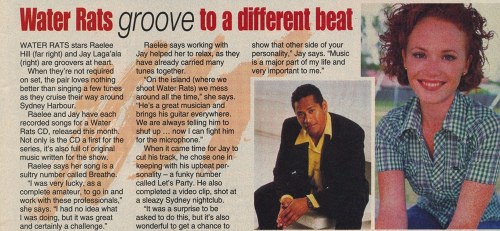
    Water Rats stars Raelee Hill and Jay Laga’aia are groovers at heart. When they’re not required on set, the pair loves nothing better than singing a few tunes as they cruise their way around Sydney Harbour.

    Raelee and Jay have each record songs for a Water Rats CD, released this month. Not only is the CD a first for the series, it’s also full of original music written for the show.

    Raelee says her song is a sultry number called Breathe.

    “I was very lucky, as a complete amateur, to go in and work with these professionals,” she says. “I had no idea what I was doing, but it was great and certainly a challenge.”

    Raelee says working with Jay helped her to relax, as they have already carried many tunes together.

    “On the island (where we shoot Water Rats) we mess around all the time,” she says. “He’s a great musician and brings his guitar everywhere. We are always telling him to shut up … now I can fight him for the microphone.”

    When it came time for Jay to cut his track, he chose one in keeping with his upbeat personality – a funky number called Let’s Party. He also completed a video clip, shot at a sleazy Sydney nightclub.

    “It was a surprise to be asked to do this, but it’s also wonderful to get a chance to show that other side of your personality,” Jay says. “Music is a major part of my life and very important to me.”

    Original content copyright TV Week.

  • Steve Bisley: Police Rescue & Water Rats

    Steve Bisley: Police Rescue & Water Rats

    TV Flashback recently spoke to Steve Bisley about his time on both Police Rescue and Water Rats. From 1993 to 1995 he played Senior Sergeant Kevin ‘Nipper’ Harris in Police Rescue and after a guest starring role in Water Rats, his character Detective Sergeant Jack Christey took over from popular character Detective Senior Constable Frank Holloway – after Colin Friels’ departure from the show.  Special thanks to Via Vision Entreatment who organised the interview to help publicise the DVD release of Police Rescue and Water Rats.

    1) How did you become involved with Police Rescue?

    I was asked to do it. They offered me the role of Nipper. He was the sergeant, he sort of ran the squad in a way. There was another guy above him, another actor, but I sort of ran the operations end of it I guess, dealing with the guys. Gary Sweet, Steve Bastoni, Tammy Macintosh, Sonia Todd, Jeremy Callaghan. It was a joy to play, absolute joy to play. Water Rats was the same. It was one of the last big dramas. After these two shows, certainly after Rats finished, was the start of the reality bite. And so the big dramas went and you had people losing weight, people cooking food, and people renovating houses. That seemed to be where it was all heading and you thought this will go away in a minute, won’t it, and it didn’t.

    But I feel the stuff that’s around at the moment is a departure, and I think we’ll go back to really good drama. And I think the quality you can see being pumped out through Netflix and Stan, people like those providers, and Netflix are here now making shows, so it just means everyone is going to have to lift their game. The local providers included. Interesting times.

    2) You were pretty much desk bound for most of Police Rescue, did you ever want more action scenes?

    I enjoyed where he sat in the show. You didn’t need another fool hanging off a rope, there was enough butch stuff going on. I really enjoyed playing Nipper and I did get to do some stunts.

    3) And what about the personal aspects of playing Nipper? Did you enjoy the family side of the character?

    Absolutely. It’s really nice, and I think the scripts were great in Police Rescue. I mean I haven’t seen it in a while, but I think it still holds up, and obviously Water Rats too, and I think that’s why they’re releasing them [on DVD], because I think there’s a return to that sort of quality.

    4) What were some of the major challenges working on Police Rescue?

    The nature of the show. We were a rescue unit, I loved the fact that every week there was a big rescue sequence, there was some really hairy stuff. Abseiling off the harbour bridge, my character had to manually operate a lift that had been stuck and the brakes failed, all that stuff. Gary Sweet abseiling off the QANTAS building in the city. We threw Steve Bastoni off Centrepoint Tower, we had him worried and his eyes were as big as dinner plates when he hit the ground. He didn’t stop jibbering for about a week. That was fairly out there. I loved it and obviously the audience did too.

    5) Jack Christey could be a bit of a cowboy, did you enjoy that part of the character?

    Yeah. It was just a different way to view the entrance of a new character. It’s often challenging to take over when there’s an established character who’s leaving the show and that baton change is hard to do, it’s challenging from an audiences point of view as well.

    6) This might be testing your memory, but did you have a favourite storyline or episode for Police Rescue and Water Rats?

    I can remember them all. I’ve got a really good memory, it’s not too good some days. In both shows there was no real standout. I liked everything about both shows, we worked very closely with the Rescue police, we were given all the uniforms, they were the real thing. Normally with police shows you’ve gotta fabricate your own uniform and it can’t be exactly the same as the real coppers, but we were able to, and they would vet all the scripts to make sure what we were doing is what they’d be doing. So you really felt this was as real as we could make it. That was great and I think that comes over on the screen, and there’s enough of each characters personal life in there to keep that side of the show interesting. So I liked them both. There was a bus crash that was pretty interesting and a lot of heartfelt stuff, and people losing their lives and we were trying to rescue them. Equally I loved Water Rats, in both cases huge amount of work to get through in a day. Television is always fast, there’s no mucking around you’ve got to be on song all the time. Theatre runs at a different pace as does film.

    7) And did the fast pace cause tension on the set?

    No, I think it creates an energy. I don’t think it necessarily create tension, I think people thrive on the energy of it. To get through the sort of hours we were doing, I think all that energy and adrenaline really helped. On both shows actually, because there’s no chance to go back, you keep going and the nature of the shows required that amount of energy on them anyway. Water Rats we were chasing down the baddies, in Rescue we were saving people. People loved that, the public like it too, when the Rescue guys turn up it’s gotta be good. I have immense respect for police, men and women. They’re the people we call when the sh*t hits the fan. It doesn’t matter what it is, we want the police, it’s like calling to your mother. No matter what, they have to attend, they have to go and that’s an extraordinary career to have. Every time the phone goes you don’t know what’s at the end of that call. These kids, police coming out of the academy, they’re in their late teens. They’re seeing the worst side of humanity on a daily basis. Carnage, destruction, sorrow, and grief. It asks a lot of anybody.

    8) What will you treasure most from your time working on Police Rescue and Water Rats, from both a professional and personal perspective?

    I think the collective of all the performers on both shows. We became very close as a group. We were spending a lot of time together obviously in the execution of those shows, people of like minds and people who were working at a real fast pace and being careful with each other in those situations and helping, being supportive and getting through. Same with the crew. The cast and crew. I’m involved in Doctor Doctor, the last 2 series, the same thing. All those shows, you get a real little microcosm of life. We all get there super early in the morning and it’s still dark and we’re there till the sun goes down and beyond. And that’s our day and that’s the next day, and the next day and the next day. And on and on it goes. It’s an extraordinary camaraderie between a group of people going in one direction, the support and friendship that comes out of that, it’s wonderful.

    9) Do you stay in contact with the cast and crew from both shows?

    Most all of them.

    10) Why do you think Police Rescue and Water Rats were so successful?

    Good people working on them, attractive shows to look at, great production values, engaging stories and great scripts. Boom.

    11) You left both shows, how do you know when it’s time to leave a show?

    I don’t know. Sometimes it’s not of your choosing and sometimes it is. It’s knowing when to hold them and knowing when to fold them.

    12) Did you have a favourite show out of Police Rescue or Water Rats?

    No. They’re both great shows.

    Thanks to Steve Bisley and Via Vision Entertainment. 

    You can now purchase the complete Water Rats and Police Rescue on DVD.

    You can see Steve Bisley in action in both Police Rescue and Water Rats in the video below:

  • TV Week: Water Rats Q & A August 22nd 1998

    TV Week: Water Rats Q & A August 22nd 1998

    TV Week
    August 22nd 1998

    Jay Laga’aia (aka Sen-Constable Tommy Tavita)

    Question: What would be the highs and lows of acting?

    Jay: Highs and lows would be doing the nude scene in the recent episode of Rats. Itís not easy pulling your pants down in front of forty crew members.

    Question: What is it like working on Water Rats and occasionally Xena: Warrior Princess?

    Jay: What I like about working on both these series is that on one show you get to play the straight good guy, there to lend a helping hand and the other you’re the bad guy ready to chop off a helping hand.

    Question: What is your birth-date and star sign?

    Jay: September 10, 1963. I’m a virgo and I like my star sign.

    Question: Where would you like to see your character head in Water Rats?

    Jay: I would like to take him a little more off the water and work on land. Not so much with the leads-co-stars Colin Friels and Catherine McClements – but with McCall (Scott Burgess) and Blakemore (Toni Scalan).

    Question: How did you get picked for Water Rats?

    Jay: I was working in New Zealand when a call came from Southern Star with a request to see me on tape. I taped an interview and got a call back saying pack your bags you’re flying to Australia. And the rest is history.

    Toni Scanlan (aka Sgt Helen Blakemore)

    Question: Apart from working on Water Rats, what do you do in your spare time?

    Toni: Cook for friends, which makes me nervous, but I like the challenge.

    Question: What would be the highs and lows of acting, especially on Water Rats?

    Toni: Highs-working on an island in the middle of the harbour! Lows-working on an island in the middle of the harbour!

    Question: What is your birthdate and star sign?

    Toni: I’m an Aries and I was born on April 2, 1956.

    Question: If you could be anybody in the world, who would you be? And why?

    Toni: Maxine McKew. She’s a fantastic journalist, great interview and not bad looking either. Seriously, I’d like to have her brains and the ease with which she deals with all kinds of people.

    Question: What other work have you done other than acting? And what was your first job?

    Toni: My first job was selling jeans in Jeans West. I’ve been involved in retail clothing and secretarial work.

    Question: Have you ever made a stuff-up when filming Water Rats?

    Toni: Often, but one time working with Colin Friels (Det. Frank Holloway) I could not get my lines out. I finally squeezed them out and when I saw it later it was shocking!

    Question: What are your favourite foods?

    Toni: Moroccan food with all its fruits and perfumes combined with lamb and cous cous, and a bottle of pinot noir. Yum!

    Question: “Do you get quizzed about the show? Does this annoy you?

    Toni: People are generally polite. They’ll say, ‘Hi’, or tell you they enjoy the show, but I’ve never been quizzed. Most folk know the difference between real life and fiction. So, when they meet you, they’re responding to you the actor, not the character and that is far from annoying.

    Original content copyright TV Week.

  • Bill Young: Water Rats

    Bill Young: Water Rats

    Veteran actor Bill Young (Hacksaw Ridge, Chopper, The Matrix) appeared in the first 19 episodes of Water Rats as Chief Inspector Clarke Webb. TV Flashback caught up with Bill to learn more about his short run on the highly successful action series.

    1) How did you become involved with Water Rats?

    It was through a standard audition process. I think my agent had done quite a sell on me to Hal McElroy the producer and so the audition at Faith Martins (the casting director) went well. I remember feeling good about it when I left.

    2) Any similarities between Clarke Webb and Bill Young?

    Well…he looks like me and is exactly the same height! My career in this industry has seen me primarily play two types of characters – man of authority, and rural f*ckwit. Clarke Webb sat comfortably within the ‘man of authority’ parameters. I think my height (197cm) has convinced directors over the years that I would have a degree of authority. I have played many, many cop roles in my career – starting with a Probationary Constable in ‘Listen to the Lion’ in 1977, through to Chief Inspector in ‘Water Rats’ (1996), and then back to long serving Sergeant in ‘The Cut’ (2008)

    3) What was it like playing a character that had a working class background but had risen to a senior role in the water police? Did that level of depth make it easier or harder to play Clarke Webb?

    It’s always easier when there is a career arc for a character rather than just a description. We received a detailed personal history of each character which was handy. Much better than the familiar ‘he’s a hard but fair man’.

    4) Your character had a strong relationship with Frank (Colin Friels) and Goldie (Catherine McClements), what was it like to work closely with Colin and Catherine?

    Friels and I got on well and scenes with him were always enjoyable. We both had a healthy degree of cynicism about the industry and I think that’s where we clicked. Both Colin and Catherine were highly professional and a pleasure to work with which makes life easier on the set with a tight schedule.

    5) Water Rats was a big action series, did you want to be more involved in the action scenes or were you happy mostly staying at water police HQ?

    I would’ve loved doing more action stuff out on location around Sydney Harbour but as the boss my stuff tended to be in the office or in a hallway. It was always a pleasure to go to work on Goat Island – lovely way to start the day! A coffee, a boat ride, and then a wander around the island – what could be better? In the opening double episode I actually did get to do a bit of action, but as the schedule tightened, things started to become more office bound. In fact even the divers spent less and less time in the water.

    6) What was it like shooting on Sydney Harbour day in and day out? Did you ever get bored of the view?

    Never. It was a glorious location. One thing however was problematic. One would think that being isolated on a small island on Sydney Harbour would be quite quiet and good for the sound recordist, but that was not the case. Water, harbour traffic and trains crossing the bridge is VERY noisey. We had to be miked very tightly and pitch up if we were outside the Water Rats’ offices.

    7) The shooting schedule for Water Rats was very gruelling, how did the cast and crew cope with the long days?

    It was tough for others, in particular the principals, but not so much for me. Some days might be flat out, but generally Clarke Webb wasn’t worked too hard! However those like the divers and the boat crew would sometimes spend a long day out on the harbour and in the sun and that would certainly see them earning the money.

    8) Your character left Water Rats in the first series, was this always planned? How did you feel about your character leaving early on? Do you feel that Clarke had more to give?

    It was always planned that way. I knew I was only doing the first series. I was very happy with that because Webb was just a supporting character and I didn’t wish to be typecast as that character as that makes it hard to get future work. Also I believe the series slowly went downhill the longer it went. I think the first 26 eps really represented the show well. The longer it went it just became yet another cop show – the hook of having divers and boats and Sydney Harbour receded, and the ‘water rats’ element disappeared. If the role of Clarke Webb had expanded, rather than as it was (desk bound and “I’ll have your badge, Frank!”), then I could possibly have been convinced to stay, but I was very happy with the decision to leave when I did.

    9) Out of the 19 episodes you worked on, did you have a favourite? Or a favourite storyline?

    Nope – not really. Maybe the marriage bust up was an interesting one for me, as Webb could be seen in a different light, rather than just ‘The Boss’. Working with Linden Wilkinson and Liz Birch was a nice change – lover and (ex) wife.

    10) What made Water Rats different from other productions you’ve worked on?

    The location. Pure and simple. It had a point of difference and Sydney Harbour is also one of the most beautiful spots in the world. Also having Colin Friels on board was terrific as he added serious cred to the show. Colin’s a fascinating actor to watch and to work with. We became pretty good mates. I shot a short film with him a few years later and it was great to catch up.

    11) What will you treasure most from your time working on Water Rats, from both a professional and personal perspective?

    My ‘Clarke Webb’ desk nameplate that the art department gave me! Sits proudly in my office. But seriously, it was a great experience to work with a professional ensemble of actors and watch a greaty crew work seamlessly to a very tight schedule.

    12) What have you been up to recently?

    I continue doing voiceover work on a regular basis and have just finished a 12 week run in a new David Williamson play which was highly successful – packed houses. And I’ve had the good fortune to appear in films such as The Great Gatsby and Hacksaw Ridge, as well as on TV in shows such as House of Bond and Rake. I also co-directed a documentary, A Very Short War, for The History Channel and the ABC. So, can’t complain – get you nowhere, anyway!

    You can purchase the complete Water Rats on DVD here.

    Thanks to Bill Young for a great interview. You can see Bill in action in Water Rats below:

  • TV Week: “Get it together!” Water Rats February 7th 1998

    TV Week: “Get it together!” Water Rats February 7th 1998

    TV Week
    February 7th 1998

    Will Frank and Goldie finally get together? We ask the writers …

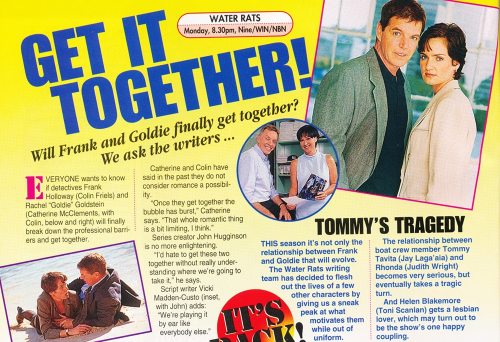
    Everyone wants to know if detectives Frank Holloway (Colin Friels) and Rachel “Goldie” Goldstein (Catherine McClements) will finally break down the professional barriers and get together.

    Catherine and Colin have said in the past they do not consider romance a possibility.

    “Once they get together the bubble has burst,” Catherine says. “That whole romantic thing is a bit limiting. I think.”

    Series creator John Hugginson is more enlightening. “I’d hate to get these two together without really understanding where we’re going to take it,” he says.

    Script writer Vicki Madden-Custo adds: “We’re playing it by ear like everybody else.”

    Tommy’s Tragedy

    This season it’s not only the relationship between Frank and Goldie that will evolve.

    The Water Rats writing team has decided to flesh out the lives of a few other characters by giving us a sneak peak at what motivates them while out of uniform.

    The relationship between boat crew member Tommy Tavita (Jay Laga’aia) and Rhonda (Judith Wright) becomes very serious, but eventually takes a tragic turn.

    And Helen Blakemore (Toni Scanlan) gets a lesbian lover, which may turn out to be the show’s one happy coupling.

    Original content copyright TV Week.